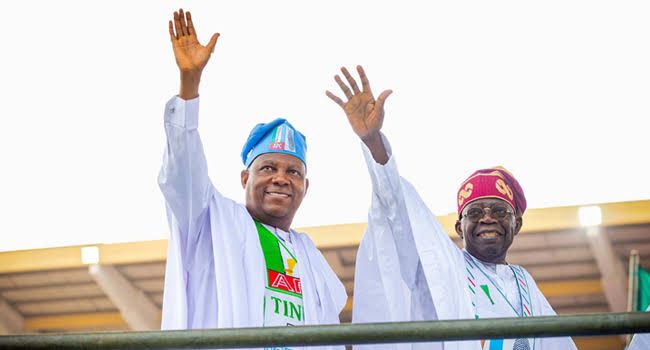
The 2026 Budget outlines major allocations for presidential travel, solar power, vehicles and aircraft logistics, highlighting governance priorities amid economic strain.
The 2026 Budget proposal submitted by President Bola Ahmed Tinubu to the National Assembly has provided a detailed picture of how the Presidency plans to allocate resources for governance, logistics, infrastructure and official travel in the coming fiscal year.
Budgetary documents show that significant sums have been earmarked for foreign trips by the President and Vice President, power infrastructure at the Presidential Villa, vehicle replacement, and the operation of the presidential air fleet.
Under the State House Operations vote, the Presidency plans to spend N6.14 billion on international travel in 2026, while the Office of Vice President Kashim Shettima is allocated N1.31 billion for similar trips.
These provisions form part of broader operational budgets amounting to N8.38 billion for the President and N2.64 billion for the Vice President.
The allocations underscore the importance attached to diplomatic engagements, international summits and bilateral meetings expected to take place during the year.
Beyond travel, the 2026 Budget reflects a strategic focus on energy sustainability within the seat of power.
A notable N7 billion has been set aside for the solarisation of the Presidential Villa in Abuja.
The project, officially described as the “Solarisation of the Villa with Solar Mini-Grid,” falls under the capital expenditure of the State House Headquarters, which has a total proposed allocation of N43.19 billion.
The decision to invest in solar infrastructure is closely linked to ongoing instability in Nigeria’s national electricity grid.
Repeated grid collapses in recent years have disrupted power supply nationwide, forcing both public institutions and private households to rely on alternative energy sources such as generators and solar systems.
By transitioning part of the Villa’s power supply to renewable energy, the Presidency appears to be seeking improved reliability and long-term cost efficiency.
Vehicle procurement and replacement also feature prominently in the 2026 Budget.
A total of N3.3 billion has been proposed for the purchase and replacement of operational vehicles for the State House.
A breakdown of the figures shows that N2.56 billion is allocated for new operational vehicles, while N768.9 million is reserved for replacing ageing SUVs.
An additional N115.4 million is earmarked for tyres for bullet-proof vehicles, ambulances, plain cars and other official automobiles used for presidential duties.
Another major spending item relates to air logistics. The federal government has proposed N283.85 billion for presidential air fleet logistics and management in 2026.
This allocation also covers funding for the national forest guard initiative.
The presidential air fleet comprises aircraft designated for the President, visiting heads of state and other top government officials, serving as a critical component of national security and executive mobility.
The 2026 Budget further shows that a substantial portion of State House funding is devoted to maintenance and the settlement of outstanding obligations.
Routine maintenance of mechanical, electrical and civil infrastructure within the Presidential Villa and other State House facilities is expected to cost N4.23 billion in the coming year.
These maintenance works are essential to keeping critical facilities functional and secure.
In addition, N8.35 billion has been allocated to settle liabilities owed to construction giant Julius Berger.
The funds are intended to cover retention fees and outstanding works across several government facilities located in Abuja and Kaduna.
These obligations stem from previously executed projects and form part of efforts to clear inherited liabilities.
President Tinubu formally presented the N58.18 trillion 2026 Budget to a joint session of the National Assembly on December 19, 2025, after securing approval from the Federal Executive Council.
The Senate subsequently passed the Appropriation Bill for second reading on December 23, 2025, marking the start of detailed legislative consideration.
As the bill undergoes scrutiny, lawmakers are expected to interrogate the proposed allocations in light of prevailing economic realities.
Rising living costs, inflationary pressures and public demand for improved social services have intensified debates around government spending priorities.
While supporters argue that investments in infrastructure, security and international engagement are necessary for effective governance, critics are calling for greater fiscal restraint and transparency.
Ultimately, the 2026 Budget serves as a financial roadmap for the Tinubu administration’s second full year in office.
How the allocations are defended, adjusted or approved by the National Assembly will shape public perception of the government’s commitment to balancing governance needs with the economic challenges faced by ordinary Nigerians.
About the Author