The US government shutdown has evolved from a political standoff into a national operational breakdown, paralyzing the country’s aviation network and forcing regulators into emergency management measures.
Forty of America’s busiest airports are now under mandatory traffic reduction orders after the Federal Aviation Administration declared an unsustainable risk to national airspace safety.
Airlines including United, Delta, and Southwest announced large-scale cancellations from Friday, beginning a nationwide chain reaction that will ground passengers and expose deep structural vulnerabilities in U.S. aviation.
Federal authorities confirmed that the reductions will start at four percent and could rise to ten percent as staffing levels collapse across critical air traffic facilities.
Aviation analysts said the directive covers every major hub from Atlanta and Dallas to Los Angeles and Chicago, cutting routes that handle millions of passengers each day.
The unprecedented directive is not limited to domestic flights but extends indirectly to launch schedules and cargo operations, disrupting coordination between air freight and passenger networks.
FAA Administrator Bryan Bedford acknowledged the scale of disruption but argued it was necessary to preserve aviation safety and prevent catastrophic breakdowns within overstressed control systems.
“This is new territory,” he said, emphasizing that the shutdown’s impact on air traffic control staffing had left no alternative but to reduce national capacity for safety reasons.
By Friday morning, Delta confirmed 170 cancelled flights, while United projected a rolling four percent cut extending through the weekend, and Southwest announced 120 immediate cancellations.
The cancellations reflect the FAA’s new scheduling thresholds, which restrict operations during peak hours between six in the morning and ten at night across high-volume air corridors.
Executives have framed their cooperation as a commitment to safety rather than a concession to inefficiency, though many quietly warn of the mounting economic impact of the crisis.
United Airlines CEO Scott Kirby stated, “We will continue to make rolling adjustments, but our highest priority remains safety under any conditions, including government dysfunction.”
Transportation Secretary Sean Duffy said air traffic controllers had been working unpaid since October, warning that fatigue was now threatening operational focus and cognitive safety at control centers.
“Missing one paycheck is survivable for many,” he said. “Missing two isn’t. This is the human breaking point that endangers the system itself.”
The FAA estimates that nearly 3,000 certified controllers are unavailable, while more than 11,000 others continue working without pay — creating the worst air traffic control shortage in history.
Experts predict more than 1,800 flights and 260,000 seats could disappear from schedules this weekend, sending ripple effects through connecting services and regional airport operations.
The order has affected all three Washington DC airports — Reagan National, Dulles, and Baltimore/Washington — grounding lawmakers and lobbyists alike, underscoring the irony of political paralysis.
American Airlines issued a statement urging Washington to reach a budget resolution, thanking unpaid federal staff who “keep the skies moving even as politics keeps the nation grounded.”
Aviation attorney Matt Stoddard said the shutdown has already delayed federal investigations, including the UPS cargo crash in Louisville that killed twelve people earlier this week.
“At minimum, inquiries will slow down,” he said, noting that every step of an NTSB investigation requires coordination with other now-understaffed or inactive federal agencies.
The aviation safety dilemma is becoming existential. Experts warn that prolonged controller fatigue could reduce reaction times, error detection, and situational awareness, increasing risk on crowded routes.
Veteran pilot John Nance described the system as “operating on borrowed time,” adding that safety margins “cannot coexist with political indecision and unpaid oversight.”
A growing sense of fragility now defines air travel across the United States, as reduced staffing transforms what was once routine coordination into an exercise in controlled improvisation.
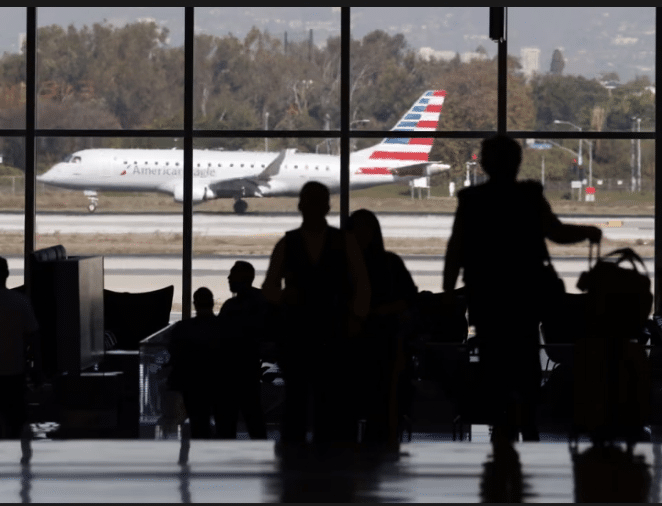
At New York’s LaGuardia and Chicago O’Hare, passengers waited in crowded terminals as screens displayed “FAA reduction advisory,” signaling the beginning of a chaotic travel weekend.
Delta and United offered flexible rebooking policies, including waivers for basic economy fares, while American and Southwest promised full refunds on routes affected by cancellations.
Yet the logistical disruption extends far beyond passengers. Aircraft repositioning schedules, maintenance intervals, and cargo relay networks are also crumbling under ongoing delays and reduced traffic.
Analysts say the financial consequences could grow exponentially, with major airlines potentially losing hundreds of millions if reductions persist through the Thanksgiving travel season.
Geoff Freeman, CEO of the US Travel Association, said, “These are difficult decisions forced by political dysfunction. It’s eroding traveler confidence and damaging America’s aviation brand.”
Economists estimate that sustained shutdown-related disruptions could cost the travel industry up to two billion dollars if unresolved before Thanksgiving, adding strain to inflation and consumer spending.
Small airports and regional carriers face particular vulnerability, relying heavily on federal coordination and staff availability for clearance, maintenance, and scheduling systems.
The cascading operational gridlock reflects a fragile interdependence — where each delayed flight generates compound disruptions throughout the entire air transport ecosystem.
Sean Duffy’s department warned of a potential “mass operational freeze” if the situation continues through November, citing reports of controllers seeking secondary jobs to offset unpaid wages.
Public frustration continues to mount. Travellers at Denver International reported sleeping on terminal floors as storm delays compounded shutdown-related flight shortages across multiple carriers.
In Miami, a passenger told reporters, “It’s surreal — you hear ‘safety reasons,’ but it feels like politics has taken over our airports and our patience.”
Aviation officials maintain that the restrictions are not political but protective, arguing that even a single fatigue-related oversight could trigger national tragedy under the current workload.
The FAA’s Air Traffic Organization, which handles more than three million passengers and 44,000 flights daily, now operates below safe staffing thresholds across multiple control zones.
Analysts have likened the crisis to the 1981 air traffic strike, noting that today’s shortages reveal systemic dependency on federal continuity that cannot survive prolonged US government shutdown.
The symbolism resonates beyond aviation. Planes grounded for lack of governance illustrate how administrative paralysis extends from Congress’s chambers into the country’s logistical bloodstream.
Economists argue that even short-term traffic reductions weaken broader market confidence, signaling that American infrastructure remains hostage to partisan dysfunction.
In this atmosphere, the economic impact extends into secondary industries — tourism, hospitality, and cargo logistics — amplifying losses across an already fragile post-pandemic recovery environment.
Policy expert Eleanor McKay said the situation represents “a visible collapse of coordination capacity,” adding that “shutdown politics has replaced operational management with national uncertainty.”
As the shutdown reaches day thirty-seven, bipartisan negotiations remain stagnant, with both Republicans and Democrats trading accusations while essential workers absorb the financial and emotional cost.
The FAA insists it will adjust reductions dynamically, but insiders admit that staffing forecasts grow worse by the day, making restoration of full capacity increasingly unrealistic.
If no funding agreement is reached before Thanksgiving, analysts fear the system could approach functional paralysis, turning seasonal congestion into an uncontrolled national aviation emergency.
For passengers, the crisis feels emblematic — a nation stuck midair, circling for political clearance that never comes, hoping safety holds until compromise returns.
The US government shutdown is no longer a headline about fiscal gridlock; it is a lived experience where governance failure manifests in grounded planes and stranded lives.
About The Author