The emergence of a Qatar-linked intelligence operation targeting the alleged victim of International Criminal Court prosecutor Karim Khan has deepened a year-long storm surrounding international justice.
What began as allegations of sexual misconduct against the chief prosecutor has now transformed into a web of espionage, political intrigue, and geopolitical maneuvering implicating private firms and state interests.
At the center lies a covert network reportedly commissioned by a Qatari diplomatic unit, said to have hired British intelligence contractors to discredit Khan’s accuser within the International Criminal Court.
Documents obtained from leaked files reveal the private firms Highgate and Elicius Intelligence pursued highly sensitive information about the woman and her family, breaching ethical and legal boundaries.
Investigators traced efforts to access passport data, travel records, and even the birth certificate of her child, pointing to the alarming depth of this Qatar-linked intelligence operation.
The woman, an ICC employee who accused Khan of coercive sexual behavior, has described the surveillance as “disturbing and heartbreaking,” highlighting how justice institutions can become arenas of intimidation.
Highgate, the London-based strategic advisory firm behind the project, admitted involvement in ICC-related operations but denied acting against individuals or working directly for Qatar’s government.
However, sources close to the matter suggest a high-level Qatari diplomatic unit funded the mission under coded references such as “client country” and “Q country.”

This covert financing highlights the blurred intersection between political influence and private intelligence, where plausible deniability shields powerful actors from accountability.
For the International Criminal Court, the scandal arrives at a moment of existential vulnerability, already shaken by accusations, resignations, and pressure from powerful states over Gaza-related investigations.
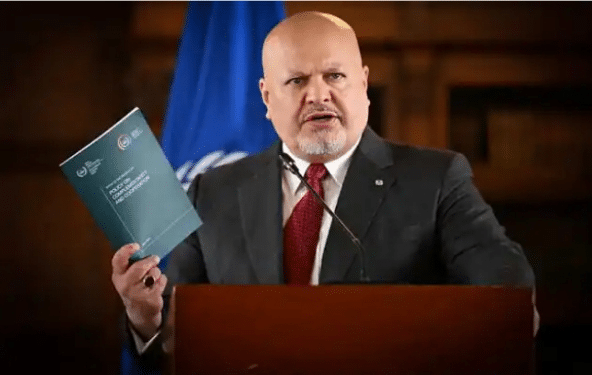
Karim Khan, who authorized warrants for Israeli Prime Minister Benjamin Netanyahu and Defense Minister Yoav Gallant, has been accused by allies of Israel of pursuing politically motivated justice.
Now, allegations of sexual misconduct and the revelation of this Qatar-linked intelligence operation converge to challenge both his personal integrity and the credibility of the ICC itself.
Khan has denied all accusations, insisting he is the victim of a coordinated campaign to undermine his authority, while asserting confidence in the ongoing UN-led inquiry.
Yet the narrative has grown darker, with confirmation that his accuser’s private communications were compromised and her online passwords surfaced on dark web archives.
Elicius Intelligence, hired by Highgate, reportedly compiled profiles on the woman’s family members and colleagues, analyzing financial data and past relationships in invasive detail.
These findings suggest a systematic effort to discredit the complainant rather than to ascertain the truth, an approach that erodes confidence in international legal oversight.
Even more troubling is the alleged attempt to link the accuser to Israel’s intelligence community—a move apparently designed to cast doubt on her motivations.
Despite exhaustive searches, the documents reviewed show no evidence of Israeli ties, undermining the justification for the surveillance and raising new questions of intent.
Legal analysts warn that the intersection of intelligence operations and judicial accountability represents a profound threat to the independence of global justice mechanisms.
One European diplomat remarked that “the moment political powers start weaponizing private intelligence against judicial officers or witnesses, the idea of impartial justice collapses.”
The Qatari government has declined to comment, maintaining official silence while critics argue that its influence campaigns increasingly reach beyond the traditional sphere of diplomacy.
This Qatar-linked intelligence operation is not an isolated instance but part of a broader global trend where state-backed contractors infiltrate international organizations to protect strategic narratives.
For Qatar, the motive may lie in defending regional alliances and countering perceptions of alignment with either Israel or Western-led legal institutions.
Observers suggest Doha’s intelligence outreach has expanded in recent years, intertwining with Western consultancies and leveraging soft-power partnerships to pursue discreet political objectives.
Highgate’s public statement portrays the operation as an “independent assessment” of attempts to undermine the ICC, but its activities tell a different story.
Leaked files show executives using encrypted communication, concealing the true client identity, and avoiding written references to Qatar in internal memos.
Such secrecy, while standard in intelligence work, reinforces suspicions that the operation was structured to protect both the financier and contractors from scrutiny.
Meanwhile, Karim Khan’s legal representatives have confirmed meetings with Highgate personnel but deny any involvement or awareness of surveillance tactics targeting his accuser.
The ICC prosecutor’s office remains silent, unwilling to jeopardize ongoing investigations or the already fragile trust within the institution’s ranks.
The broader consequence is a chilling effect across the international justice ecosystem, where potential whistleblowers may now fear becoming targets of similar intelligence interventions.
Human rights advocates warn that the Qatar-linked intelligence operation marks a turning point for transparency, signaling how foreign states can manipulate judicial processes through covert proxies.
Such manipulation undermines the delicate balance between global accountability and state sovereignty—the foundation on which international law depends for legitimacy.
Khan’s own future remains uncertain, as he continues to step aside pending the UN inquiry while critics exploit the controversy to question the ICC’s authority.
Inside The Hague, morale among ICC staff has reportedly declined, with whispers of resignations and internal divisions over whether Khan can continue effectively if cleared.
Diplomats have privately expressed fear that this crisis could delay prosecutions tied to war crimes in Gaza, Ukraine, and Sudan, weakening the court’s moral standing.
Experts note that intelligence-linked disruptions have historically preceded political efforts to undermine the ICC’s jurisdiction, as seen in previous U.S. and Israeli lobbying campaigns.
This pattern suggests a deliberate strategy: discredit the prosecutor, fracture institutional unity, and stall accountability for powerful political or military actors.
The Qatar-linked intelligence operation fits seamlessly into this geopolitical pattern, exploiting private contractors and gray networks of influence to reshape narratives at the highest levels.
In doing so, it has forced uncomfortable questions about the neutrality of Western intelligence consultancies and their willingness to serve competing international agendas.
The scandal also exposes a deeper moral dilemma within intelligence ethics: how far should private agents go when their assignments intersect with victims of alleged abuse?
Civil society groups argue that without a binding global framework regulating private intelligence activities, abuses like this will continue with impunity under commercial pretexts.
For the alleged victim, the damage is deeply personal—her credibility smeared, her privacy violated, and her professional career entangled in a geopolitical storm she never sought.
Her words echo the despair of many within international institutions: “If this is what global justice looks like, it is not the system I believed in.”
The United Nations inquiry into Khan’s behavior is expected to conclude soon, though few anticipate its findings will heal the reputational wounds inflicted upon the ICC.
Whatever the outcome, the revelation of a Qatar-linked intelligence operation has already redrawn the boundaries of influence and exposed new vulnerabilities in global justice systems.
The ICC, designed to stand above politics, now finds itself entangled in espionage, statecraft, and private enterprise—an uncomfortable reflection of power’s reach in the modern era.
Analysts caution that unless transparency mechanisms are strengthened, the ICC could become a battlefield for intelligence wars masquerading as justice disputes.
This erosion of trust may deter cooperation from member states, slow investigations, and embolden those who view the court as an instrument of selective prosecution.
Meanwhile, Qatar’s silence, coupled with the firms’ evasive denials, ensures ambiguity will persist—fueling conspiracy theories and diplomatic mistrust across The Hague’s corridors.
For many observers, the scandal underscores how intelligence and influence now dominate the same space where law once reigned supreme.
Ultimately, the Qatar-linked intelligence operation represents not merely a controversy but a paradigm shift in how international power is exercised and concealed in the twenty-first century.
As geopolitical rivalries intensify, private intelligence firms may increasingly become the tools through which states wage invisible wars over justice, reputation, and truth itself.
The International Criminal Court’s credibility now hinges not only on legal outcomes but also on whether it can shield itself from the encroaching shadow of political espionage.
In the long run, this affair will be remembered less for its immediate scandal and more for what it reveals about the fragility of institutions built on global trust.
If unchecked, such covert entanglements will ensure that every pursuit of justice comes with its own hidden surveillance file, waiting to rewrite the narrative from the shadows.
The Qatar-linked intelligence operation, therefore, is both a symptom and a warning—one that challenges the very meaning of accountability in a world governed by competing truths.
About The Author