

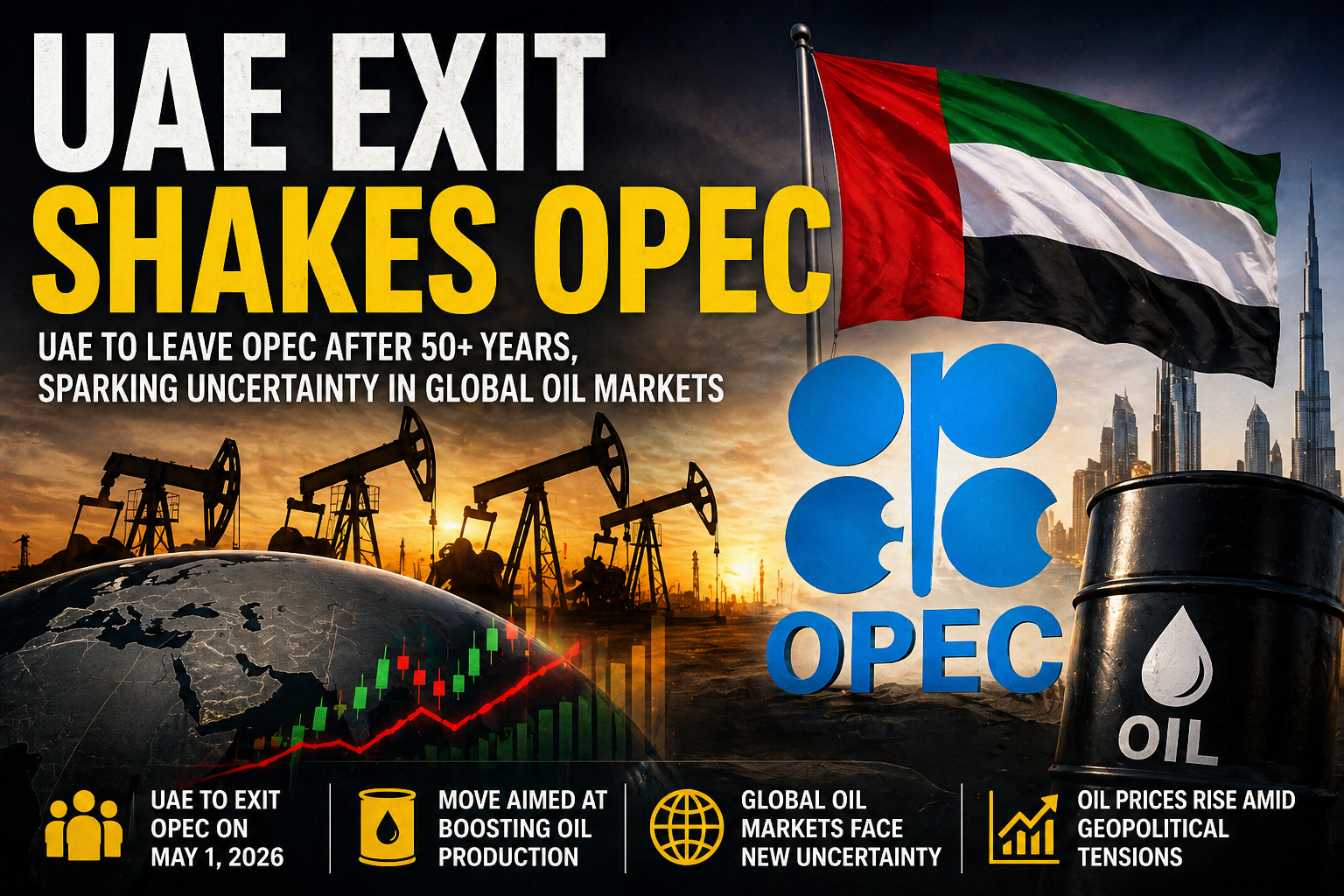
UAE exits OPEC shakes oil markets as Brent surges, FX pressure and capital flight fears intensify
Global markets reacted sharply after the United Arab Emirates confirmed it will leave OPEC, with Brent crude rising above $107 per barrel, emerging-market bond yields climbing past 10%, and currencies in oil-importing economies coming under pressure.
The move, now widely tracked as “UAE exits OPEC”, is forcing investors to reassess inflation risk, capital flows and currency stability…
Within hours of the announcement, the shock rippled through financial systems: emerging-market Eurobond yields hovered between 10% and 13%, while the U.S. Dollar Index held firm above 105, tightening global liquidity conditions and amplifying pressure on import-dependent economies.
What initially appeared as a geopolitical shift quickly escalated into a full-scale macro-financial repricing event.
The decision means that “UAE exits OPEC” is no longer just an energy headline—it is now a market-moving trigger with implications for inflation, currencies, and capital allocation globally.
Structural Break in Oil Market Coordination
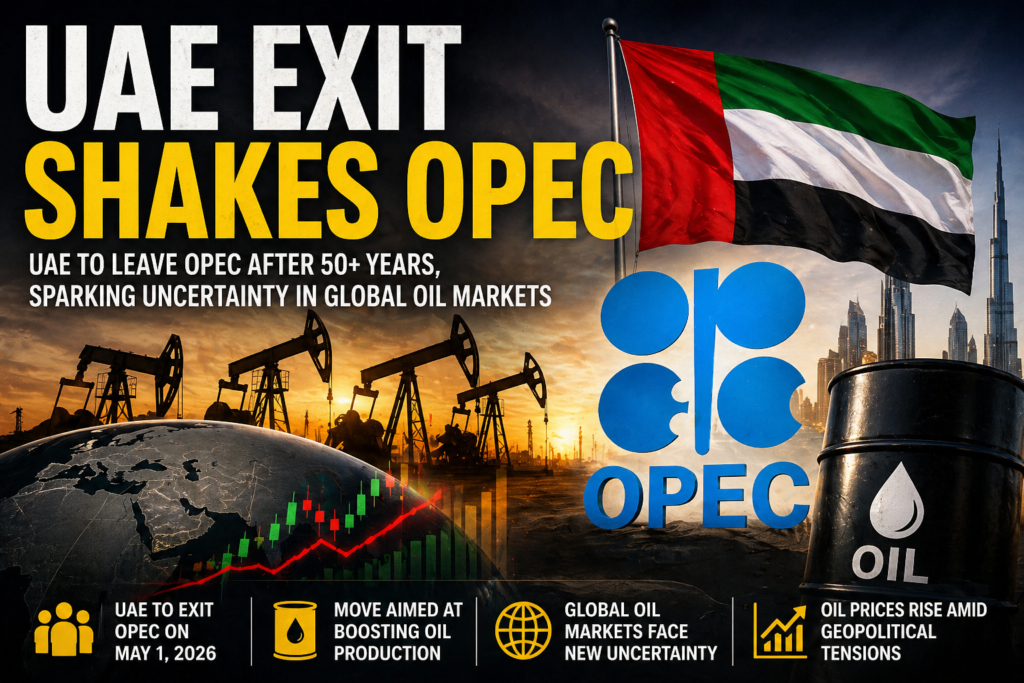
The UAE said it will formally withdraw from the Organization of the Petroleum Exporting Countries and the wider OPEC+ alliance effective May 1, 2026, citing the need for greater production flexibility and alignment with national economic priorities.
For nearly six decades, the United Arab Emirates has been a core pillar of OPEC coordination, often working alongside Saudi Arabia to enforce supply discipline. Its exit introduces a structural rupture in the cartel’s internal balance of power.
Energy analysts say the move injects a new layer of uncertainty into oil markets that had already been strained by geopolitical tensions and supply route disruptions.
“This is not about immediate supply loss—it’s about the erosion of coordination credibility,” said Amrita Sen, co-founder of Energy Aspects.
“Markets are now pricing a higher structural risk premium into oil.”
Oil Markets Reprice Risk, Not Just Supply
The immediate reaction in oil markets was less about barrels and more about expectations.
Brent crude’s move above $107 reflects what traders describe as a “coordination risk premium”—a pricing adjustment driven by fears that OPEC+ may struggle to maintain unified production discipline without one of its key Gulf producers.
The shift is already changing market behaviour, with volatility rising and forward price expectations adjusting..
In effect, markets are moving away from coordinated supply management toward a more uncertain pricing environment.
FX Transmission: Oil Shock Feeding Inflation
The impact is also showing up in currency markets, where higher oil prices are feeding into inflation through exchange rate pressure.
Because crude is priced in dollars, higher oil prices increase global demand for USD. For emerging markets, this typically weakens local currencies, amplifying the cost of imports.
Economists estimate that a 10% rise in oil prices can pass through 2%–4% into consumer inflation within 60 to 90 days, depending on currency stability and subsidy structures.
The chain is straightforward: higher oil prices increase dollar demand, weaken local currencies, and raise the cost of imports.
The reality is that when UAE exits OPEC, the impact does not stop at oil markets; it filters directly into food, transport, and energy costs globally.
Bond Markets Signal Rising Risk Premiums
Sovereign debt markets are reflecting a similar recalibration.
Emerging-market Eurobond yields remain elevated in the 10%–13% range, signaling persistent investor caution toward economies exposed to commodity shocks and currency volatility.
At the same time, U.S. Treasury yields continue to anchor global pricing, pulling capital toward safer assets.
Investors are responding by demanding higher returns to hold riskier asset, particularly in economies where oil price volatility translates into fiscal and inflation instability.
“Energy volatility is now a central variable in sovereign risk pricing,” said a London-based emerging markets strategist at JPMorgan.
“Countries with weak FX buffers are being repriced more aggressively.”
Global Capital Is Rotating — And Not Equally
At the same time, a clearer shift is emerging: global capital is moving away from fragile import-dependent economies and concentrating in markets with stronger macro buffers and energy leverage.
- The United States continues to attract safe-haven inflows through Treasuries and dollar strength
- India is drawing over $80bn annually in infrastructure and manufacturing investment, supported by strong demand fundamentals
- Brazil is benefiting from commodity-linked inflows tied to agriculture and energy exports
By contrast, capital allocation to high-risk frontier markets is tightening as investors reassess exposure to FX volatility and inflation shocks.
This is not happening suddenly, but the direction is becoming
Money is leaving vulnerable, import-heavy economies and flowing toward scale, stability, and commodity advantage.
The shift is becoming increasingly directional. Capital is rotating out of FX-fragile, import-dependent markets and into scale-driven economies with stronger buffers.
Human Impact: Inflation Hits Households Directly

While markets adjust through models and pricing, the real impact is already being felt at the household level.
Across several import-dependent economies, the pressure is already measurable. Food inflation is running between 18% and 30% year-on-year, while transport costs have jumped 15% to 25% in major urban centres, forcing households to allocate as much as 60% of income to food and basic consumption.
For many families, even a modest increase in fuel prices is now translating into immediate cuts in protein consumption and transport mobility.
Energy-driven inflation tends to cascade quickly into everyday expenses. Transport fares rise first. Food prices follow.
Recent data across emerging markets shows:
- Food inflation running between 18% and 30% year-on-year
- Transport costs increasing by 15%–25% in urban centres
- Households now spending 50%–65% of income on food and basic consumption
For lower-income groups, this creates a direct squeeze on purchasing power, reducing discretionary spending and increasing vulnerability to economic shocks.
In practical terms, when UAE exits OPEC, the effect is not abstract—it translates into higher daily living costs within weeks.
Related: Oil prices surge past $107 as US–Iran tensions escalate, triggering inflation and market fears
OPEC+ Faces Fragmentation Pressure
The UAE’s departure also exposes deeper fractures within OPEC+.
The alliance, formed in 2016 to stabilise oil markets after a price collapse, has increasingly struggled with diverging national priorities. Some producers seek higher output to fund domestic growth, while others prioritise price stability.
Removing a key player reduces not just output coordination capacity but also diplomatic cohesion.
Markets are watching closely to see whether remaining members can maintain production discipline
UAE’s Strategic Bet: Flexibility Over Coordination
From Abu Dhabi’s perspective, the move is strategic.
The UAE has been expanding production capacity, investing heavily across oil, gas, and renewables, and positioning itself as a low-cost, lower-carbon producer.
By exiting OPEC constraints, it gains flexibility to optimise output timing and align production with national investment goals.
This reflects a broader shift among energy producers: from collective discipline toward strategic autonomy.
A Market Entering a More Fragile Equilibrium
The immediate effect may not be a supply shock, but it points to a more fragile pricing environment.
Markets rely not just on supply and demand, but on expectations of coordination. When coordination weakens, volatility rises—even without physical shortages.
That is what is now unfolding.
The phrase “UAE exits OPEC” has become shorthand for a deeper transformation in global energy governance, one where predictability is giving way to conditional cooperation.
Conclusion: From Stability to Structural Uncertainty
The UAE’s exit marks a turning point in how global oil markets function.
It introduces a new layer of uncertainty into pricing, accelerates inflation transmission through FX channels, raises sovereign risk premiums, and reshapes global capital flows.
For investors, policymakers, and households alike, the message is the same:
The era of predictable oil coordination is fading—and markets are already adjusting to a more volatile, fragmented future.
Ultimately, the implications of “UAE exits OPEC” extend beyond oil, reshaping inflation expectations, capital allocation, and sovereign risk pricing across global markets.
Read more @ireport247new
About The Author
