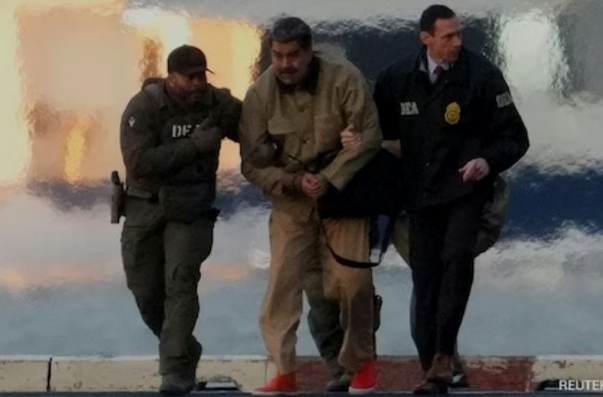
President Donald Trump pledged “total safety, total security” for American oil companies in Venezuela, urging them to participate in Trump Venezuela oil investment by putting $100bn into the country’s energy infrastructure after US forces removed Nicolás Maduro from power.
At a White House roundtable, executives from Chevron, ExxonMobil, and ConocoPhillips attended, highlighting Trump’s push to prioritize US firms in Venezuela’s post-Maduro reconstruction.
Trump emphasized that “the plan is for them to spend, meaning our giant oil companies will be spending at least $100bn of their money, not the government’s money”, making clear these investments are the responsibility of the companies themselves, “not the federal government.”
He also assured them, “They don’t need government money, but they need government protection and government security.”
Executives expressed tentative support for the administration’s approach, with several hinting that they stood ready to invest in Venezuela’s energy sector.
Analysts remain skeptical that such rapid, large-scale investments are feasible given ongoing regulatory and political uncertainties.

Trump warned that if the executives hesitated, “I got 25 people that aren’t here today that are willing to take your place.”
His statement underscored both urgency and the administration’s determination to secure American-led oil development.
While offering “total safety”, Trump acknowledged that some firms did not require government assistance. “These are people that drill oil in some pretty rough places,” he said, “I could say a couple of those places make Venezuela look like a picnic.” His point highlighted corporate experience in hazardous operations.
Earlier this week, Trump suggested that Venezuela’s oil production could increase within 18 months, an ambitious target given local infrastructure challenges.
He stressed that funding would come from private companies rather than taxpayers, emphasizing government protection and government security as key support.
The $100bn investment plan aims to modernize refineries, revamp pipelines, and expand extraction capabilities.
Trump framed it as mutually beneficial, offering US firms access to massive reserves while helping Venezuela rebuild its energy sector.
Despite optimism, executives expressed caution, citing asset seizure risks, political instability, and currency volatility.
These challenges underscore the complexity of Trump Venezuela oil investment, which requires careful navigation of both operational and regulatory hurdles.
Trump positioned the plan as a combination of opportunity and security. By highlighting “total safety” and emphasizing private funding, he projected confidence while minimizing federal financial exposure. This approach reflects a strategy blending corporate initiative with US oversight.
Analysts note that rapid mobilization of $100bn is unlikely, given legal and geopolitical barriers. Yet, Trump’s insistence demonstrates the administration’s intent to place US energy companies at the center of Venezuela’s oil production following Maduro’s removal.
During the meeting, Trump again stressed “total safety” and government protection and government security, attempting to reassure executives.
The pressure tactic—“I got 25 people that aren’t here today that are willing to take your place”—reinforced urgency, emphasizing the high stakes of inaction.
The roundtable reflects a broader policy approach: using private capital for US strategic gains in volatile regions.
Trump Venezuela oil investment exemplifies this model, prioritizing corporate funding while leveraging government protection to secure influence in Venezuela’s energy sector.
Executives’ reactions ranged from cautious optimism to practical concern. Many acknowledged the opportunity but highlighted the logistical and regulatory risks of operating in a country with complex governance and historical instability. Trump’s repeated assurances of “total safety, total security” sought to mitigate these worries.
Trump repeatedly reminded participants that this investment plan relies on companies’ own resources. “The plan is for them to spend, meaning our giant oil companies will be spending at least $100bn of their money, not the government’s money,” he said. This reinforced the distinction between private responsibility and public oversight.
By combining promises of “total safety” with warnings of replacement, Trump conveyed a clear message: immediate engagement is expected.
The approach illustrates the administration’s strategy of incentivizing US firms to rapidly assert influence in Venezuela’s oil industry.
The projected $100bn would allow modernization of refineries, strengthening of supply chains, and expansion of extraction operations, aiming to make Venezuela a competitive player in global energy markets once again. This plan relies heavily on American corporate investment and government security support.
Trump emphasized that firms with prior experience in challenging conditions were well-positioned. “These are people that drill oil in some pretty rough places,” he said, “I could say a couple of those places make Venezuela look like a picnic.” He used this to argue for confidence in Trump Venezuela oil investment outcomes.
The meeting also addressed risks and obstacles. Executives expressed concern over political and economic instability but were encouraged by Trump’s promise of “total safety” and oversight.
Analysts caution, however, that real-world execution may face delays due to Venezuela’s uncertain environment.
Overall, the roundtable showcased Trump’s determination to secure American dominance in Venezuela’s energy sector.
Through Trump Venezuela oil investment, he aims to combine private capital, corporate expertise, and US government protection to rebuild the oil industry while limiting taxpayer expenditure.
Executives left with a clear understanding of expectations: investment must be company-funded, timely, and backed by US security guarantees.
Trump’s repeated statements of “total safety, total security” and warnings about replacements reinforced urgency and potential reward.
Read also: Russia fires hypersonic Oreshnik missile at Ukraine in massive strike
By the end of the session, the plan for Trump Venezuela oil investment was clearly outlined: companies provide the capital, the US government provides security, and Venezuela’s oil sector is rapidly rebuilt. The initiative is framed as a strategic win for American energy interests globally.
Trump’s approach demonstrates a combination of political pressure, private capital reliance, and strategic oversight, illustrating how Trump Venezuela oil investment is positioned as a centerpiece of post-Maduro economic policy. The plan emphasizes private initiative, federal protection, and rapid deployment of resources.