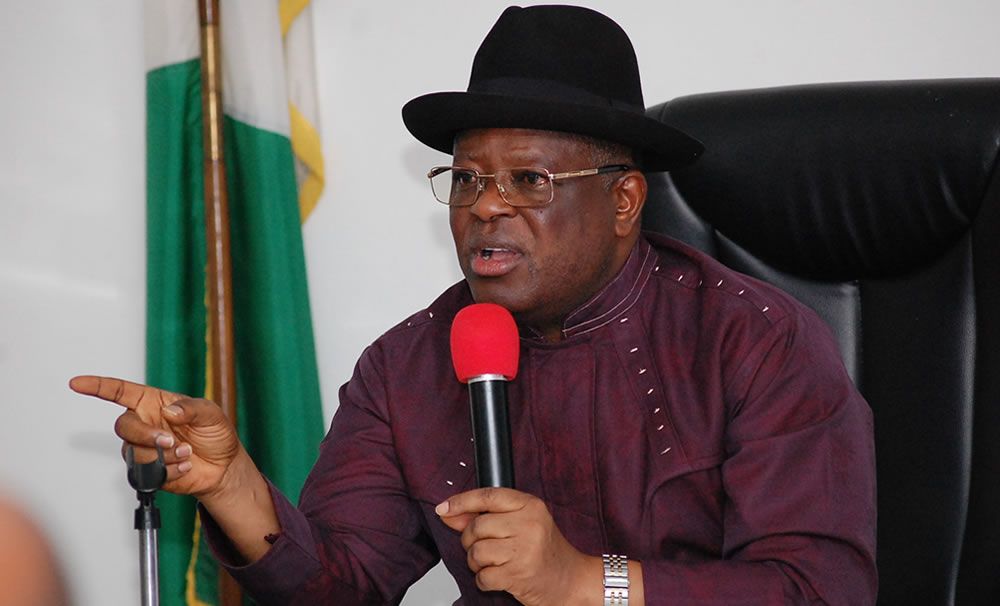
PDP crisis worsens as Senator Samuel Anyanwu petitions DSS, Police, and INEC over alleged forgery of his signature, intensifying tension before convention.
The PDP crisis has taken a more dramatic turn as the National Secretary of the Peoples Democratic Party, Senator Samuel Anyanwu, petitions the Department of State Services (DSS), the Inspector General of Police, and the Independent National Electoral Commission (INEC) over an alleged forgery of his signature.
The shocking development, now under investigation, has deepened internal discord within the party ahead of its scheduled November National Convention.
In three separate petitions dated October 15, 2025, and submitted the following day to the agencies, Anyanwu claimed that a letter purportedly signed by him and addressed to INEC was falsified.
The document, dated August 29, 2025, allegedly informed INEC about the upcoming national convention — but the secretary insists he neither signed nor approved it.

According to him, the forged communication represents an “attempt to deceive both the party and electoral institutions,” which could cause irreparable harm to the integrity of the PDP.
He has therefore urged the DSS and Police to launch an immediate investigation and prosecute those responsible.
The alleged forged letter, titled “Peoples Democratic Party (PDP) Year 2025 Elective National Convention,” carried reference number PDP/DOM/GF.2/Vol.1M/25-140 and was sent to INEC in August.
Anyanwu explained that he was first alerted when reports surfaced of INEC receiving an official correspondence bearing his name and signature.
In his petition titled “Petition Against Forgery and Cloning of My Signature,” Anyanwu wrote:
“My attention has been drawn to the above-titled letter to INEC with reference number PDP/DOM/GF.2/Vol.1M/25-140, dated Monday, August 25, 2025, purportedly signed by me. Regrettably, the quoted letter was never signed, authorised, or known to me. It is shocking to have a forged or cloned version of my signature on such a sensitive document.”
He attached an excerpt of the forged letter for verification and called on the security agencies to act swiftly to restore confidence in the party’s administrative process.
Petitions to INEC, DSS, and Police
In his letter to INEC Chairman, Anyanwu expressed concern that party insiders could collude with external actors to manipulate official records. He described the act as “criminal, unethical, and damaging to democratic governance.”
To the Director General of the DSS, he wrote that the alleged forgery constituted “a serious national security concern,” especially since the PDP remains one of Nigeria’s leading opposition platforms.
His petition to the Inspector General of Police similarly urged “a comprehensive investigation into this criminal conduct by officers of the PDP and their collaborators within INEC,” stressing that justice must be served to prevent a repeat of such internal sabotage.
Internal Power Struggles Intensify
The PDP crisis predates the forgery allegations, with the party deeply divided over leadership control and convention preparations.
Despite its decision to hold the National Elective Convention in Ibadan, Oyo State, on November 15–16, internal wrangling has persisted, particularly among factions loyal to the Minister of the Federal Capital Territory, Nyesom Wike, and those aligned with the Acting National Chairman, Ambassador Umar Iliya Damagum.
The key points of contention include leadership control in the South-South zone, party structures in Cross River, Akwa Ibom, Plateau, and Rivers States, and disagreements over the micro-zoning formula for party offices.
The divisions have spilled into the judiciary, as several PDP members have sought court intervention to halt the convention until internal disputes are resolved.
Court Dispute Over Party Representation
In suit number FHC/ABJ/CS/2120/25, PDP chairmen from Imo and Abia States, Austin Nwachukwu and Amah Abraham Nnanna, together with the South-South Zonal Secretary, Turnah Alabah George, accused the Damagum-led National Working Committee (NWC) of breaching the party’s constitution and election guidelines.
They listed INEC, the PDP, Ambassador Damagum, and several senior members as defendants.
During a recent hearing before Justice James Omotosho of the Federal High Court, Abuja, confusion erupted when two Senior Advocates of Nigeria — Kamaldeen Ajibade (SAN) and Chief Chris Uche (SAN) — both claimed to be representing the PDP.
The judge consequently ordered both lawyers to provide documentary proof of their authorisation before the next sitting, which was adjourned to October 20, with a directive for all parties to exchange court papers by October 17.
Leadership Dispute Over Legal Adviser
The legal confusion deepened when 14 members of the National Working Committee signed a letter dated October 16, 2025, reaffirming their decision to remove Kamaldeen Ajibade (SAN) as the party’s National Legal Adviser, replacing him with Chief Chris Uche (SAN).
Ajibade, however, rejected the move, insisting that only a National Convention has the constitutional authority to remove him.
“I remain the legitimate National Legal Adviser of the PDP,” he told reporters.
“The purported decision of some NWC members cannot override the party’s constitution.”
The development further underscores how the PDP crisis has evolved beyond political rivalry into a full-blown institutional conflict threatening party stability.
Political Implications and Expert Views
Political observers view the alleged forgery and legal battles as symptoms of a deeper structural weakness within the PDP. Analysts warn that the controversy could undermine the opposition party’s credibility and affect its preparations for the 2027 general elections.
Political analyst Dr. Raymond Eze noted:
“The PDP crisis has reached a level that threatens its relevance as a national opposition force. Allegations like forgery erode public trust and expose the fragility of its internal democracy.”
Some party insiders have privately expressed fears that the crisis could pave the way for the ruling party to tighten its grip on national politics. Others, however, see the current turmoil as an opportunity for internal reform, urging the leadership to confront corruption and restore transparency.
Effect on the Upcoming Convention
The ongoing PDP crisis has thrown the fate of the November convention into uncertainty. Sources within the party reveal that some state chapters are divided over participation, citing concerns about legitimacy and internal manipulation.
Preparations for the event, which is expected to produce a new National Executive Committee, have slowed considerably due to the multiple litigations and allegations of forgery.
INEC has acknowledged receiving Anyanwu’s petition but stated that it would await the conclusion of security investigations before issuing an official response.
Observers believe that unless unity is restored quickly, the PDP risks conducting a controversial convention that could further fracture the party’s already fragile cohesion.
Many see Senator Anyanwu’s petition as a potential turning point in the PDP crisis. His insistence on transparency, according to political watchers, may trigger a new wave of accountability within the opposition.
However, there are fears that exposing the forgery scandal could also worsen distrust among factions. Several party elders have reportedly urged reconciliation efforts to prevent total disintegration.
Anyanwu, for his part, has vowed to pursue justice, maintaining that no individual or group should be above the law. “The truth must be established,” he said, “and the perpetrators must face the consequences.”
As the PDP crisis deepens, the party finds itself entangled in allegations of forgery, leadership rivalry, and legal confusion. What began as internal disagreement over convention arrangements has now spiralled into a test of integrity and institutional discipline.
With the DSS, IGP, and INEC drawn into the investigation, the PDP faces a defining moment that could either restore credibility or plunge it deeper into chaos. For Nigeria’s leading opposition, the outcome of this controversy will determine not just the success of its convention but its relevance in the nation’s democratic future.
More news at ireport247news
About The Author