Nnamdi Kanu files a fresh motion seeking transfer from Sokoto prison, arguing the distance blocks his appeal rights and access to legal resources.
The leader of the Indigenous People of Biafra, IPOB, Nnamdi Kanu has submitted a new motion before the Federal High Court in Abuja, insisting that his continued detention in the Sokoto Correctional Facility is obstructing his ability to challenge the life sentence recently imposed on him.
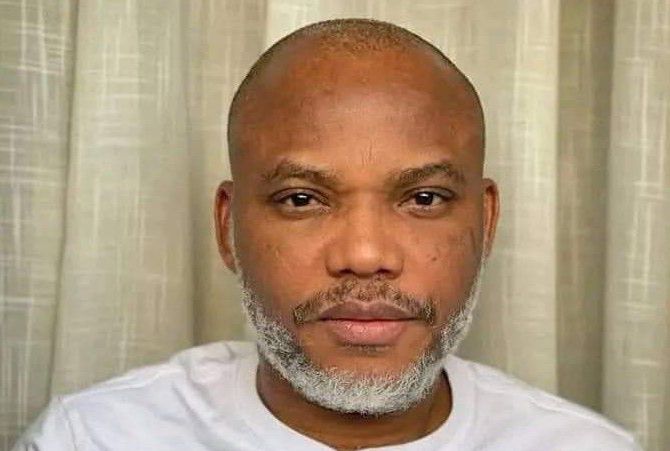
According to him, the long distance between Sokoto and Abuja has created severe limitations, making it nearly impossible to coordinate or file the necessary documents for his appeal.
In the application, which he personally signed, Nnamdi Kanu explained that he intends to exercise his constitutional right to appeal without legal representation for now.
However, preparing the notice of appeal and assembling the supporting documents requires consistent interaction with the court registries in Abuja, a task he says cannot be carried out effectively while held more than 700 kilometres away.
The motion was presented in court by his younger brother, Prince Emmanuel Kanu, who told the judge that the detained IPOB leader was unable to appear physically to move the application.
He urged the court to hear the request in his absence since the motion had already been duly filed and endorsed by the convict.
Justice James Omotosho, however, refused to allow Emmanuel to argue the matter, stating clearly that only a qualified legal practitioner can move an application on behalf of an individual.
The judge explained that the law does not permit a non-lawyer to represent a human being in court under any circumstances.
He advised Nnamdi Kanu to hire a lawyer or seek support from the Legal Aid Council before the motion can be heard.
Following this directive, Emmanuel requested a new date for hearing, which the court adjourned to December 8.
Justice Omotosho also took time to warn the public against spreading inaccurate claims about the case, noting that one of the convict’s former lawyers had wrongly stated that the appeal records could not be compiled because of his location.
The judge clarified that a convict does not need to be physically present in court for the compilation of appeal records, though someone acting lawfully on his behalf must be available to follow the procedure.
He further noted that the rights available to a defendant during trial differ significantly from those available after conviction.
In his motion, Nnamdi Kanu reminded the court that following his sentencing on November 20, an order was issued directing that he could be held in any correctional centre except Kuje.
The Nigerian Correctional Service subsequently transferred him to Sokoto on November 21.
He argued that this decision has severely hindered his access to relatives, legal researchers and other persons who could help with his appeal — all of whom are based in Abuja.
The IPOB leader insisted that remaining in the Sokoto facility amounts to exceptional hardship and a clear violation of his constitutional rights.
He is therefore urging the court to direct the federal government or the Nigerian Correctional Service to relocate him to any custodial facility within Abuja.
As an alternative, he proposed being transferred to either the Suleja or Keffi Correctional Centre, both of which are close enough to enable meaningful access to the courts.
By filing this motion, Nnamdi Kanu is seeking what he believes is the minimum requirement necessary to pursue the only legal remedy still open to him — the right to appeal his life sentence and conviction.
Ireport247news