

Moldova displayed a Russian drone after summoning Moscow’s ambassador over the incident, calling the crash “totally unacceptable” and highlighting repeated violations of its airspace.
The small ex-Soviet nation, wedged between Ukraine and NATO member Romania, has repeatedly witnessed Russian overflights since Moscow’s 2022 invasion of its neighbor, raising diplomatic tensions.
Moldova’s foreign ministry summoned Oleg Ozerov, Russian ambassador to Chișinău, presenting a formal protest note while placing the recovered Gerbera drone outside ministry headquarters.
“This is not a minor violation,” said a senior Moldovan diplomat, stressing that sovereignty must be respected and repeated airspace incursions pose serious security challenges in Europe.
The Gerbera drone, reportedly Russian-made, fell on Moldovan soil without prior notice, sparking outrage among officials and prompting calls for international condemnation of Moscow’s actions.
Moldova has previously expelled dozens of Russian diplomats, signaling its frustration with Russia’s consistent provocations, which it regards as violations of international norms and diplomatic protocol.
“We cannot accept any infringement of our territory,” stated a foreign ministry official. “This drone crash is a blatant disregard for Moldova’s sovereignty and international law.”
The ambassador, Oleg Ozerov, inspected the drone amid tense discussions at the foreign ministry. Moldovan authorities emphasized the incident “seriously undermines trust and regional stability.”
Western allies closely monitor Moldova, a country not formally part of NATO but strategically located near Ukraine, where Russia continues its military operations and aggressive air campaigns.
In recent months, Moldova reported multiple Russian aerial violations, including drones and reconnaissance flights, which the government has repeatedly labeled as unacceptable breaches of its sovereignty.
“This is a pattern, not an isolated event,” a government spokesperson said. “Russia’s actions jeopardize not only Moldova’s safety but regional peace and international security.”
Officials note that the Gerbera drone crash follows similar incidents along Moldova’s borders, creating heightened alert levels and prompting calls for stronger defensive measures.
International experts have described Moldova’s public display of the drone as a diplomatic warning, signaling that repeated incursions will not be tolerated and will have consequences.
“The presentation of the drone is a clear message: Moldova will defend its territory,” an analyst in Eastern European security told AFP. “This is both symbolic and practical.”
Local media covered the drone extensively, emphasizing that the incident reignites fears of spillover from the Ukraine conflict and Moldova’s vulnerability to aerial provocations.
“The crash reminds us that Moldova is directly affected by the war in Ukraine,” said a political commentator. “We live next to a battlefield, and Russian drones are part of this reality.”
Moldovan authorities have repeatedly called on Russia to respect airspace and international borders, citing the 2022 invasion of Ukraine as a backdrop to ongoing security concerns.
“Repeated airspace violations are not mere accidents,” said a defense official. “They are provocations that challenge Moldova’s neutrality and threaten civilian safety.”
The foreign ministry emphasized that the drone’s crash is “a serious violation” of sovereignty and an “unacceptable risk” to both government facilities and local communities in Chișinău.
International observers have urged calm while calling on Moscow to clarify the incident, stressing that diplomatic dialogue is essential to prevent further escalation in the region.
Experts note that drones like the Gerbera are often used for surveillance or strikes, and their appearance over Moldova raises questions about Russia’s strategic intentions near NATO-aligned territories.
“This incident could have wider implications for regional security,” noted a European policy analyst. “Moldova’s proximity to Ukraine makes it particularly sensitive to Russian air operations.”
Moldova’s government is considering stricter measures, including improved radar tracking and closer coordination with NATO partners, to ensure that future incursions are quickly detected and addressed.
“The safety of our citizens is paramount,” a spokesperson said. “We cannot allow repeated violations of our airspace without a strong response.”
Russia has not officially commented on the drone crash. Meanwhile, Moldovan officials remain firm, asserting that sovereignty violations will not go unanswered and diplomatic measures will continue.
Observers say the incident underscores the precarious position of countries bordering the Ukraine conflict, where airspace integrity is increasingly challenged by military technologies like drones.
“The Gerbera drone landing is more than an accident,” a defense expert said. “It is a reminder that Moldova is at the intersection of regional tensions and must remain vigilant.”
Moldova continues to document incursions and inform international bodies, highlighting the need for accountability and emphasizing that overflights are “totally unacceptable” and endanger civilian safety.
Officials expect that repeated overflights, combined with the current war in Ukraine, will shape Moldova’s defense planning and international diplomatic strategies for the foreseeable future.
“This is a call for stronger international cooperation,” a government source said. “Neighboring countries and allies must be aware of the risks posed by unauthorized drones and airspace violations.”
The public display of the Russian Gerbera drone, along with the formal protest to Ambassador Oleg Ozerov, demonstrates Moldova’s commitment to defending sovereignty and sending a clear message to Moscow.
Moldovan leaders stress that the drone incident is part of a larger pattern of aggressive Russian activity and that international attention is crucial to prevent further escalation or accidents.
“This is about sending a strong signal,” an analyst said. “Moldova is small but determined to protect its borders, and the world is watching how Russia responds.”
Diplomatic observers suggest that Moldova’s actions—summoning the ambassador and publicly displaying the drone—may influence other countries facing airspace challenges near conflict zones.
“This sets a precedent,” a European diplomat remarked. “It shows that even small nations can assert sovereignty and make violations publicly accountable.”
The Gerbera drone’s recovery and exhibition are likely to remain a symbol of Moldova’s resistance to unchecked incursions, reinforcing its stance against Russian overflights and regional instability.
Officials note that these actions, combined with public diplomacy, aim to prevent normalization of airspace violations and to emphasize that Moldova will not tolerate repeated breaches.
“This is not only a legal issue but a matter of national pride,” a government official stated. “Our airspace is not open to violation, and Moscow must understand the consequences.”
The drone incident adds to broader concerns about civilian safety, military escalation, and the potential for mistakes or accidents in the contested airspace near Moldova and Ukraine.
Moldova continues to engage with European partners, emphasizing the importance of surveillance, early warning systems, and international support to safeguard its territory from future drone incidents.
“This episode is a reminder that our nation is at the frontline of regional security,” said the foreign ministry. “Vigilance and diplomatic firmness remain our top priorities.”
The formal protest delivered to Ambassador Oleg Ozerov, combined with the public display of the drone, is intended to make clear that repeated airspace violations will not go unnoticed or unchallenged.
Moldovan authorities maintain that while the Gerbera drone did not cause casualties, it represents a serious breach of national airspace that cannot be ignored in the context of ongoing regional conflicts.
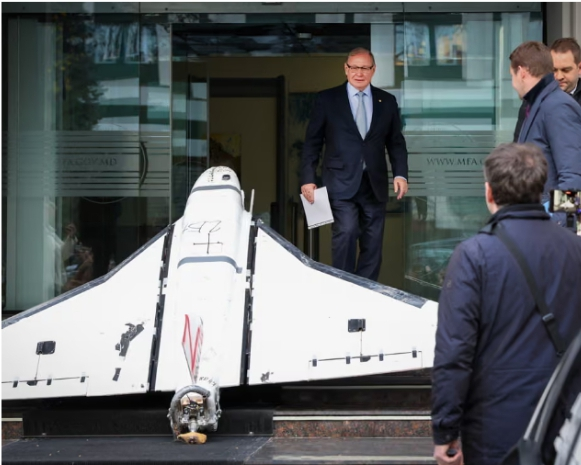
Observers conclude that Moldova’s response balances firm diplomacy with symbolic action, sending a message to both Moscow and the international community that sovereignty must be respected.
Moldova displayed the Russian drone to assert territorial integrity, convey international concern, and underline the importance of accountability in preventing further escalation near sensitive borders.
About The Author


