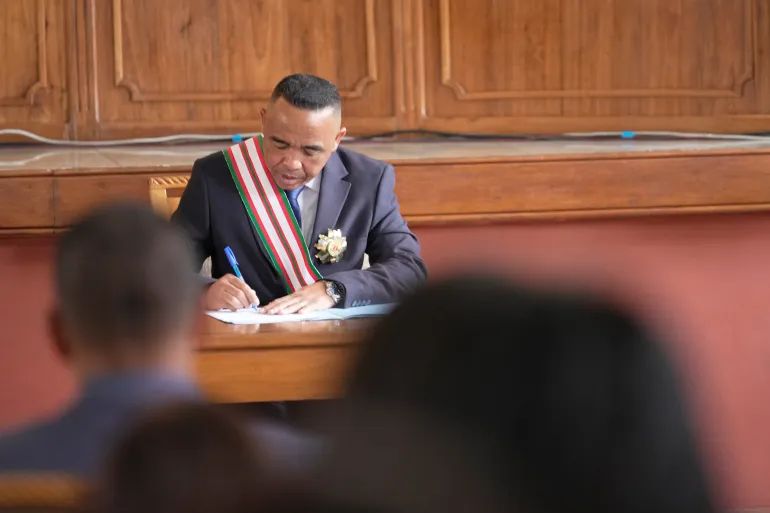
Madagascar names new prime minister Mamitiana Rajaonarison days after President Michael Randrianirina dissolved the previous cabinet, signaling a decisive political move to reset governance and reinforce public trust. The cabinet reshuffle comes amid ongoing reform plans and a broader transitional agenda.
Rajaonarison, previously head of the Financial Intelligence Unit (SAMIFIN), has experience in public administration and financial oversight.
His appointment follows the dismissal of former Prime Minister Herintsalama Rajaonarivelo, who had led the government since Randrianirina assumed power in October 2025 following widespread protests.
President Randrianirina, who emphasized integrity and principled leadership in his address, said the nation “needs bold decisions” to navigate this critical period. He highlighted Rajaonarison’s role in steering the government along a path of accountability and stability.
The cabinet changes come after public unrest, including protests over water and electricity shortages, which escalated in September 2025. Parts of the military sided with demonstrators, prompting former President Andry Rajoelina to flee Madagascar. Randrianirina insists that the transition of power was legally sanctioned by the Constitutional Court and has pledged a two-year roadmap to stabilize the country.
Rajaonarison’s leadership is seen as a key element in Randrianirina’s “Refoundation” plan, aimed at rebuilding public trust, reinforcing institutional authority, and advancing governance reforms. Analysts suggest the dismissal of Rajaonarivelo was influenced by calls for deeper reform and online campaigns advocating accountability.
The new prime minister is expected to announce his cabinet soon, with priorities likely to include transparency, financial oversight, and anti-corruption measures. Madagascar’s transition plan also envisions broad national consultations, drafting a new constitution, and presidential elections scheduled for late 2027.
Political observers note that Rajaonarison’s appointment could shape the country’s political landscape over the next two years. Velomahanina Razakamaharavo, a researcher at the University of Reading, remarked, “This decision reflects both public demands for accountability and strategic planning by the administration to ensure political stability.”
The government faces ongoing challenges, including restoring public services, stabilizing the economy, and meeting the expectations of the Gen Z movement that helped propel Randrianirina to power. Rajaonarison’s ability to balance reform and stability will be closely watched nationally and internationally.
Madagascar’s economic outlook is another critical factor for the new government. The country has faced recurring energy and water shortages, coupled with inflationary pressures and supply chain disruptions.
Analysts predict that Rajaonarison’s technocratic experience may help implement targeted reforms to address these challenges while maintaining social stability.
International observers are also monitoring the transition closely, as Madagascar’s strategic position in the Indian Ocean makes its political stability significant for regional trade and diplomatic relations.
Diplomatic engagement with France, China, and other international partners will likely influence how Rajaonarison’s government prioritizes foreign investment, infrastructure projects, and anti-corruption initiatives.
Read also: Ukraine seeks money and technology in return for Middle East drone support
About The Author