

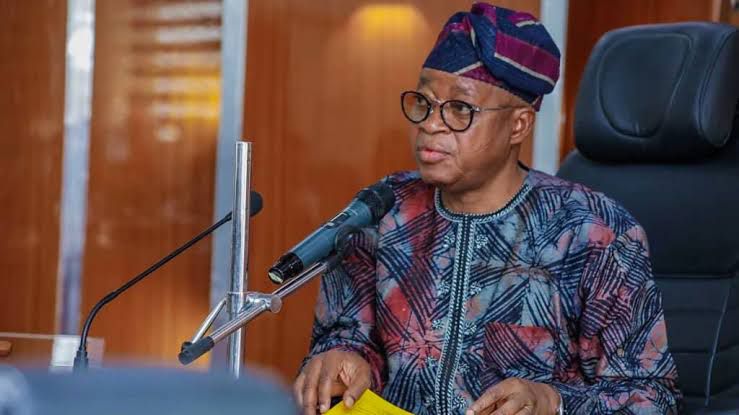
Nigeria’s Minister of Marine and Blue Economy, Adegboyega Oyetola, has raised fresh concerns over the slow growth of the fisheries sector across West and Central Africa, warning that persistent infrastructure gaps and limited access to funding are undermining the region’s vast aquatic potential.
Speaking at a high-level fisheries investment conference in Monrovia, Adegboyega Oyetola said the sector remains critical to food security and economic sustainability, yet continues to face structural bottlenecks that limit productivity and investment.
Infrastructure deficits stall regional fishing sector growth
The minister noted that despite abundant marine and inland water resources across the Gulf of Guinea, the regional fishing industry is struggling with outdated infrastructure, weak logistics systems, and insufficient financing mechanisms.
He stressed that these constraints have prevented the sector from reaching its full economic potential.
According to him, fisheries and aquaculture support millions of livelihoods across the subregion, while also serving as one of the most affordable sources of protein. However, declining fish stocks, poor cold-chain systems, and inadequate processing facilities continue to hinder value creation.
He explained that the challenges are interconnected, pointing out that limited access to modern fishing technology and credit facilities has made it difficult for operators to scale production or improve efficiency.
Oyetola emphasised that without targeted investments and policy reforms, the sector risks further stagnation, particularly at a time when population growth is increasing demand for food and employment opportunities.
Regional cooperation seen as critical to fisheries development
The minister called for stronger collaboration among countries in West and Central Africa, noting that fish stocks naturally migrate across national boundaries, making unilateral policies ineffective.
He highlighted the role of the Fisheries Committee for the West Central Gulf of Guinea in promoting coordinated governance, including joint patrols, data sharing, and enforcement of fishing regulations.
According to him, illegal, unreported, and unregulated fishing remains a major threat to sustainability, costing the region billions of dollars annually. He argued that tackling the problem requires a unified regional strategy supported by technology and intelligence-sharing frameworks.
Oyetola further noted that harmonising fisheries policies across countries would improve trade flows, attract foreign investment, and strengthen regional value chains.
Nigeria pushes reforms under Tinubu’s blue economy agenda
The minister disclosed that the Federal Government under Bola Tinubu is repositioning fisheries and aquaculture as central pillars of the blue economy strategy.
He said ongoing reforms are focused on boosting local fish production, reducing reliance on imports, and improving regulatory oversight. These measures, he added, are already yielding positive outcomes, particularly in export markets.
Nigeria, he noted, has continued to maintain access to international markets for shrimp exports, a development attributed to improved compliance with global standards and enhanced monitoring systems.
Beyond fisheries, the government is also investing in maritime security, port modernisation, and environmental protection. Oyetola pointed out that recent improvements in maritime safety have boosted investor confidence, especially in the Gulf of Guinea.
Investment gaps across value chain remain a major concern
Despite policy progress, the minister acknowledged that significant funding gaps persist across the fisheries value chain. He identified aquaculture development, processing facilities, cold storage infrastructure, and export logistics as critical areas requiring urgent investment.
He stressed that unlocking financing for small-scale operators and private sector players would be key to driving sustainable growth in the industry.
According to him, the sector holds strong potential to generate employment, particularly for young people, if supported by the right mix of policies and capital investment.
He added that expanding access to finance would enable operators to adopt modern technologies, improve yields, and reduce post-harvest losses, which remain a major issue in the region.
Sustainability key to long-term growth
Oyetola underscored the importance of sustainable resource management, warning that overfishing and environmental degradation could undermine future gains if not properly addressed.
He called for responsible management of oceans, rivers, and coastal ecosystems, noting that long-term benefits can only be achieved through conservation and regulated exploitation.
The minister also highlighted ongoing regional initiatives aimed at improving sustainability, including vessel monitoring systems and coordinated enforcement operations.
These efforts, he said, are designed to ensure that marine resources are protected while supporting economic growth and food security.
Outlook for regional fisheries sector
Industry analysts say the fisheries sector in West and Central Africa stands at a critical juncture, with significant opportunities for growth if structural challenges are addressed.
With rising demand for seafood, expanding populations, and increasing interest in the blue economy, the sector is expected to play a more prominent role in regional development.
However, experts warn that without improved infrastructure, stronger regulatory frameworks, and increased investment, the region may continue to underperform despite its natural advantages.
Oyetola concluded that sustained collaboration between governments, private investors, and development partners would be essential to unlocking the sector’s full potential and ensuring long-term resilience.