The announcement that India surpasses Japan to emerge as the world’s fourth-largest economy has reverberated across global economic circles, not merely because of its symbolic weight, but due to the deeper narrative it represents — a disciplined trajectory of reform, productivity growth, and sustained national planning.
According to International Monetary Fund (IMF) estimates for 2025, India’s nominal GDP is projected at approximately $4.187 trillion, overtaking Japan at about $4.186 trillion, and now positioning itself in strategic pursuit of Germany’s $4.74 trillion economy.
Beyond the global headlines, this milestone holds profound lessons for Nigeria — a country that once shared comparable economic momentum with India, yet today trails significantly across key economic and social indicators.
India Surpasses Japan: Tracing Divergent Growth Paths Between India and Nigeria
The point at which India surpasses Japan is not a coincidence; it is the result of years of cumulative investment in human capital, technology, industrial policy, and macroeconomic stability.
Historical World Bank estimates reveal that in 2007, India’s GDP per capita hovered around $1,022 while Nigeria stood notably ahead at about $1,816.
At that time, both countries were classified among rising emerging economies with promising growth outlooks.
By 2015, the trajectory remained relatively similar. India’s GDP per capita rose to approximately $1,584, while Nigeria’s remained higher at about $2,586.
These figures reflected potential — but also signaled a choice point.
While India deepened institutional reforms, expanded its manufacturing and services base, and scaled technological innovation, Nigeria’s economic progress became increasingly vulnerable to policy inconsistencies, oil-dependency, fiscal leakages, and infrastructure gaps.
Fast-forward to IMF projections for 2025 — the contrast is stark. India’s GDP per capita is projected to reach about $2,878, while Nigeria’s is expected to fall sharply to around $807.
The moment that India surpasses Japan therefore highlights more than a global ranking shift; it underscores lost opportunities and widening economic disparity.
India Surpasses Japan: Lessons Nigeria Must Confront on Governance, Spending, and Productivity
The fact that India surpasses Japan at a time when Nigeria has recorded unprecedented subsidy savings, revenue inflows, and borrowing raises urgent questions about fiscal accountability and economic direction.
Nigeria’s combined government revenue between 2023 and 2025 is estimated at nearly ₦200 trillion (approximately $135 billion).
Yet, critical outcomes remain weak across healthcare, education, poverty reduction, and infrastructure development.
Rather than catalyzing social welfare and enterprise growth, many households and businesses face heightened hardship.
Inflationary pressures have eroded consumer purchasing power.
Electricity remains unreliable and expensive, small and medium-scale businesses continue to shut down, and the costs of transportation, accommodation, and food have soared beyond affordability for millions of citizens.
These realities indicate not merely economic challenges — but leadership and governance shortcomings.
Where India invested in industrial capacity, digital infrastructure, entrepreneurship ecosystems, and export competitiveness, Nigeria’s spending patterns have frequently tilted toward recurrent expenditure, debt servicing, and governance overheads, with limited impact on productivity or job creation.
India Surpasses Japan: Why Nigeria Needs Competent, Compassionate, and Reform-Driven Leadership
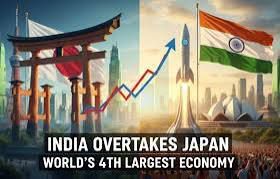
As India surpasses Japan, the imperative for Nigeria is not comparison for prestige — but reflection for transformation.
Nigeria requires a visionary, disciplined, and people-centered governance framework anchored on competence, compassion, and strong ethical leadership.
Such leadership must prioritize:
- strategic investment in healthcare, education, and technology
- support for businesses and job creation
- agriculture and food security
- energy reliability and industrialization
- transparent fiscal management and public accountability
Nigeria must also significantly reduce the cost of governance, eliminate waste, and institutionalize systems that allow citizens to track and evaluate national performance.
Economic empowerment cannot be abstract — it must translate into real opportunities, living-wage jobs, credit support for enterprises, and an enabling environment for innovation and productivity.
Beyond economics, strengthening national security, restoring investor confidence, and rebuilding trust in public institutions remain fundamental prerequisites for progress.
India Surpasses Japan: Charting a New Development Vision for Nigeria
The development trajectory symbolized by the fact that India surpasses Japan demonstrates that national advancement is neither accidental nor automatic.
It is a cumulative outcome of intentional planning, stable policy execution, and inclusive stakeholder engagement.
For Nigeria to close the widening gap with emerging global economies, it must mobilize collective national will and foster a shared leadership consensus across political, economic, and civic institutions.
The country’s vast natural and human resources can only translate into prosperity when guided by transparency, accountability, and clear developmental priorities.
A future-focused Nigerian growth model must therefore commit to:
- industrial diversification beyond oil
- digital and knowledge-economy expansion
- rural and urban infrastructure renewal
- youth skills development and employment pathways
- strong anti-corruption enforcement mechanisms
Only through such structural reforms can Nigeria ensure that its revenues and borrowing translate into measurable improvements in living standards, economic resilience, and national competitiveness.
The reality that India surpasses Japan is a global economic milestone — but for Nigeria, it is also a sobering reminder of unrealized potential and deferred transformation.
Other nations are moving forward with strategic clarity and long-term planning.
Nigeria must not remain trapped in cycles of mismanagement, inequality, and stagnation.
With unified collective action, disciplined governance reforms, and visionary leadership committed to the welfare of citizens, Nigeria can reclaim its trajectory and build a prosperous, equitable, and secure nation for all.
A new Nigeria remains possible — but the time for decisive action is now.