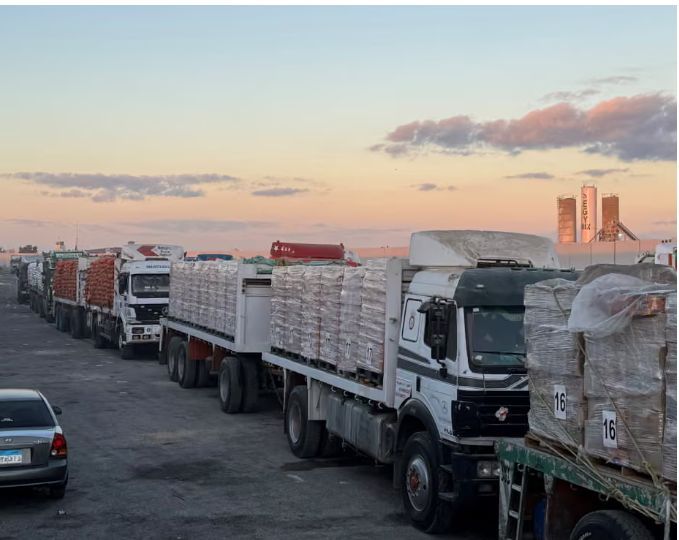
Humanitarian aid trucks lined the road at the Rafah crossing, poised to enter Gaza for the first time since the ceasefire agreement was announced last week.
Aid organizations had anticipated the resumption of humanitarian aid, with hundreds of trucks carrying critical food, medical supplies, and equipment awaiting clearance at the Egyptian border for entry.
More than 300,000 displaced Palestinians had returned to northern Gaza, an area now in desperate need of aid, including clean water, emergency food, and basic medical treatment supplies.
At least 400 trucks were reported heading toward Gaza, yet delays in border formalities meant aid distribution remained uncertain, causing tension among officials and aid agencies alike.
The ceasefire faced early challenges when Israel accused Hamas of delaying the return of hostage remains, leading to a temporary reduction in trucks delivering humanitarian aid into the territory.
Hamas later handed over the remains of three hostages, raising the total transferred to eight, signaling that aid could resume more fully in the coming days.
The group cited difficulties locating burial sites amid widespread destruction, which delayed further handovers and hindered humanitarian aid from reaching the populations most in need immediately.
Israel’s decision to reopen the Rafah crossing followed confirmation that Hamas intended to return four additional bodies, allowing humanitarian aid to begin moving despite ongoing logistical challenges in Gaza.
Heavy equipment for infrastructure repairs and the return of Palestinians displaced during the war were now permitted, enabling aid efforts to focus on reconstruction and resettlement.
Medical evacuations remained complicated, with patients awaiting notification from the World Health Organization, highlighting that aid alone could not address all immediate health crises in Gaza.
Amjad al-Shawa of the Palestinian NGO network emphasized that aid needs were immense, particularly in cities formerly bustling with commerce and culture, where rubble and destruction dominate the streets.
“Optimism exists, but quick improvement on crossings is essential,” Shawa said, noting that despite humanitarian aid shipments, damage remains widespread and streets unsafe due to unexploded ordnance.
Rafah had been closed since May 2024, with Israeli control limiting entry points, and prior restrictions on humanitarian aid had exacerbated food shortages and water scarcity in the territory.
The United Nations had previously declared famine in parts of Gaza, stressing that humanitarian aid was urgently required to prevent further civilian suffering and widespread malnutrition among children.
The European Union stood ready to deploy its longstanding EUBAM mission at Rafah, indicating international support for humanitarian aid delivery if security conditions and border management improved.
Aid officials warned that the scale of destruction meant humanitarian aid would take time to reach all affected areas, and priorities would include hospitals, shelters, and displaced families in northern Gaza.
Although the truce stipulated that Hamas should disarm in later phases, the organization continued asserting control, making humanitarian aid distribution dependent on careful negotiation and cooperation with local authorities.
Trump’s earlier plan had emphasized the return of hostages by a specific deadline, but logistical challenges meant humanitarian aid remained the more immediate concern while bodies were located and transferred.
On Monday, Israelis celebrated the release of the last 20 living hostages, while Palestinians rejoiced at Israel releasing approximately 2,000 detainees, with humanitarian aid delivery now becoming a visible sign of the ceasefire.
Far-right Israeli politicians criticized the aid flow as insufficient and morally compromised, yet humanitarian aid remained the primary mechanism to mitigate the ongoing human suffering caused by the conflict.
The Hostages Family Forum confirmed the identities of three deceased hostages, while humanitarian aid efforts continued to be complicated by political sensitivities and the need for secure transfer routes.
Bodies were retrieved under the supervision of the International Committee of the Red Cross, which noted that humanitarian aid provision was closely linked to hostage negotiations and rubble-clearing operations.
Aid organizations reported that outpatient clinics had drastically reduced operations due to shortages, highlighting the critical importance of sustained humanitarian aid for nutrition and medical treatment.
Humanitarian aid now also included fuel and water trucks, urgently needed to maintain hospitals and shelters, as electricity shortages continued to hamper daily life in Gaza.
Officials stressed that humanitarian aid distribution required coordination between multiple agencies, including local authorities, the Red Cross, and international organizations, to ensure equitable access across the territory.
Palestinian families returning to damaged homes faced an uncertain future, with humanitarian aid aimed at basic survival while reconstruction remained largely on hold pending ceasefire stability.
Even as humanitarian aid trucks moved into Gaza, residents faced extreme hardship, and experts warned that longer-term food, water, and medical needs would persist despite the influx of supplies.
Tess Ingram from UNICEF emphasized that initial shipments of humanitarian aid were far below the scale required, and continued efforts would be necessary to prevent widespread suffering among children and the elderly.
The ceasefire’s later phases, including governance arrangements and potential international stabilization forces, could significantly affect how humanitarian aid is distributed and monitored across Gaza in the coming months.
Aid organizations acknowledged that debris clearance and infrastructure repair were critical to making humanitarian aid effective, as many neighborhoods remained inaccessible due to rubble and unexploded ordnance.
Despite logistical challenges, the delivery of aid represented a tangible improvement for civilians, offering hope that the ceasefire could provide more than symbolic relief in a deeply affected territory.
The international community emphasized that humanitarian aid needed to continue irrespective of political disagreements, as civilian survival and recovery depended on consistent access to basic necessities.
Humanitarian aid had become a lifeline, yet officials cautioned that sustainable distribution required ongoing coordination, security guarantees, and effective communication with both Israeli and Palestinian authorities.
Aid convoys entering Gaza represented a milestone after months of blockade, illustrating the critical role of humanitarian aid in alleviating immediate suffering and rebuilding trust among affected populations.
Officials reported that humanitarian aid priorities included food security, water sanitation, and medical services, with additional focus on families displaced from northern Gaza who had returned to heavily damaged areas.
Though hostages’ returns were politically charged, humanitarian aid remained the immediate concern for most residents, whose survival depended on uninterrupted deliveries of food, water, and medical supplies.
The situation underscored the fragility of the ceasefire, as aid flow could be disrupted by political disputes, emphasizing the need for constant monitoring and negotiation to maintain access.
Humanitarian aid distribution highlighted the interconnected challenges of post-conflict recovery, including health, shelter, and education, alongside broader efforts to stabilize Gaza under ongoing international supervision.
Aid agencies cautioned that without sustained humanitarian aid, the recent ceasefire might fail to provide meaningful relief, leaving tens of thousands of displaced and vulnerable Palestinians at risk.
As trucks moved slowly across the border, humanitarian aid symbolized both hope and fragility, showing that even small deliveries were crucial for families enduring months of deprivation and destruction.

With aid now beginning to reach northern Gaza, residents faced the challenge of rebuilding amidst uncertainty, while continued coordination remained essential to ensure that aid reached the most vulnerable.
Even as political and security concerns persisted, humanitarian aid represented a practical step toward mitigating immediate suffering, highlighting the role of international organizations in facilitating relief efforts under difficult conditions.
Aid trucks were expected to continue arriving daily, yet experts warned that recovery would require sustained attention and resources, as immediate relief alone could not address the depth of destruction.
For civilians in Gaza, humanitarian aid was a lifeline bridging the gap between a conflict-ridden past and the possibility of gradual recovery, illustrating the tangible impact of coordinated international response.