

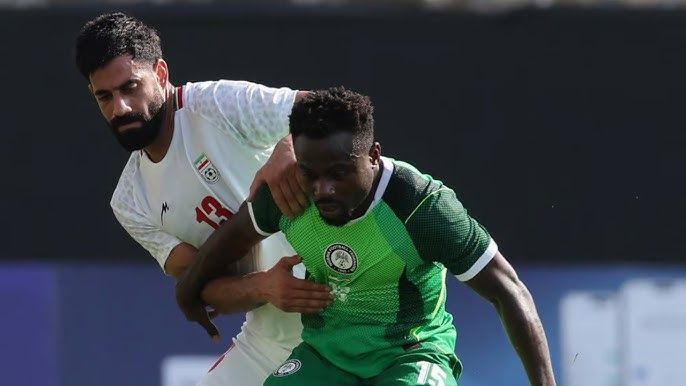
Iran coach Amir Ghalenoei admitted the Super Eagles were strong and physical in Friday’s four-nation tournament clash, which ended in a 2-1 defeat for Iran in a high-intensity encounter that tested their preparation.
Moses Simon opened the scoring after just five minutes, catching the Iranian defence off guard. His early goal set the tone for Nigeria, showcasing the Super Eagles’ speed, composure, and tactical sharpness in attack.
Six minutes into the second half, Nigeria doubled their advantage through a well-worked team move. Ademola Lookman delivered a precise assist for Adams, who finished calmly to make it 2-0, leaving Iran chasing the game.
Iran managed to pull one back in the 67th minute thanks to Mehdi Taremi. The striker finished clinically, reigniting hopes and creating a tense final phase where the Super Eagles faced increased pressure from the Iranian side.
Reacting after the game, Ghalenoei praised the Super Eagles’ approach, highlighting the physicality and intensity they brought to the match. “I think this was a very useful preparation game,” he said, emphasizing its importance.
The Iranian coach added, “Especially since we were able to implement Plan B in defense against a strong and physical team like Nigeria,” acknowledging that tactical adjustments were essential against a robust opponent.
Ghalenoei further explained the quality of the Nigerian squad, noting that “Nigeria was a very good team, and all eleven players on this team play in major European leagues such as Spain, Italy, England, France, Greece and Turkey.”
He emphasized that facing players competing in top leagues provides invaluable experience for Iran’s national team. The match allowed the coaching staff to evaluate both defensive structure and offensive transitions under pressure.
“The national team needs such games,” Ghalenoei continued. “We also tried to use more players. Fortunately, with the new rules and the possibility of making eight substitutions, we had a good opportunity to evaluate different players.”
This friendly match offered Ghalenoei the chance to rotate the squad and test players who might not normally start in competitive matches, providing a broader perspective on team depth and versatility.
From the start, the Super Eagles applied pressure, forcing Iran to adjust their shape frequently. Nigeria’s strong, physical approach made it difficult for Iran to maintain possession and build sustained attacks.
Moses Simon’s early goal was the result of coordinated pressing, quick passing, and exploiting spaces between Iran’s defensive lines. His pace troubled the Iranian defenders, forcing immediate tactical responses.
The second goal by Adams, assisted by Lookman, reflected Nigeria’s ability to execute rehearsed plays under pressure. It highlighted the combination of technical skill and physical endurance that defines the Super Eagles’ style.
Despite the two-goal deficit, Iran responded with tactical discipline. Mehdi Taremi’s 67th-minute goal demonstrated Iran’s ability to capitalize on opportunities, showing composure and accuracy under challenging circumstances.
Ghalenoei praised the Super Eagles’ physicality and acknowledged Iran’s own challenges in coping with it. His comments suggest a focus on improving resilience and adapting defensive strategies for future high-level matches.
Implementing Plan B allowed Iran to test different formations and defensive setups. By experimenting in a friendly, Ghalenoei can better understand which tactical systems are effective against strong, European-experienced opposition.
The match also provided a benchmark for individual player performance. Substitutions enabled Ghalenoei to evaluate how different athletes responded to physical duels, high-intensity pressing, and transitions between attack and defense.
Nigeria’s squad depth was evident. Players competing in leagues across Spain, Italy, England, France, Greece, and Turkey brought experience, tactical awareness, and physical endurance, presenting a formidable challenge to the Iranian team.
By facing such opponents, Iran’s national team can identify areas for improvement in stamina, positioning, and defensive coordination. Ghalenoei emphasized that games against elite squads are crucial for long-term development.
The friendly offered lessons beyond scorelines. Players experienced realistic match pressure, including quick counterattacks, aerial challenges, and rapid ball recovery, mirroring conditions in official international competitions.
Ghalenoei’s use of eight substitutions maximized player exposure and allowed the coaching staff to observe how each individual contributed to both defensive and offensive phases of play.
The experience also highlighted the importance of adaptability. Iran’s squad had to adjust quickly to Nigeria’s pressing style, physical duels, and rapid transitions, testing both tactical understanding and mental resilience.
For younger or less-experienced Iranian players, the match was an invaluable learning opportunity. Exposure to high-level competition accelerates development and helps players build confidence against elite opponents.
Ghalenoei’s reflection indicates a broader strategy: Iran’s preparation for tournaments requires not only tactical refinement but also mental toughness, physical endurance, and versatility under diverse match conditions.
The 2-1 result, while disappointing, is a benchmark for improvement. Iran can now focus on enhancing defensive cohesion, finishing efficiency, and transitional play, using insights gathered from the Super Eagles’ strong and physical style.
Overall, the friendly showcased Nigeria’s strength and Iran’s ability to respond under pressure. While the Super Eagles’ physical approach dominated, Iran gained valuable data and practical experience to refine tactics.
Ghalenoei’s comments suggest confidence in the squad’s potential to adapt. “We also tried to use more players,” he said, highlighting a proactive approach in squad evaluation for upcoming competitive fixtures.
The match underscores the value of international friendlies in assessing readiness. Iran’s national team now has a clearer understanding of strengths, weaknesses, and areas requiring tactical innovation.
Moving forward, Ghalenoei will likely use lessons from the friendly to optimize training sessions, defensive strategies, and attacking schemes, ensuring the team can cope with physically dominant opponents.
The Super Eagles’ display of speed, technical ability, and physicality provides Iran with a concrete example of what to expect against top international teams in upcoming tournaments.
Read more here:Super Eagles edge Iran 2-1 in Antalya friendly thriller
For the fans, the match offered excitement, competitiveness, and insight into Iran’s preparation. Observers noted both the challenges faced and the resilience shown, giving hope for improvement in future matches.
Finally, Ghalenoei remains focused on long-term growth. The experience gained, insights into player capabilities, and tactical lessons from facing a strong, physical team like Nigeria will inform Iran’s strategies for years ahead.
Read more: Ireport247news