

Abubakar Malami has been summoned by EFCC, promising transparency, cooperation, and public disclosure as Nigeria watches developments unfold in the investigation.
The former Attorney-General of the Federation and Minister of Justice, Abubakar Malami, has once again taken the spotlight following an official summons from the Economic and Financial Crimes Commission (EFCC).
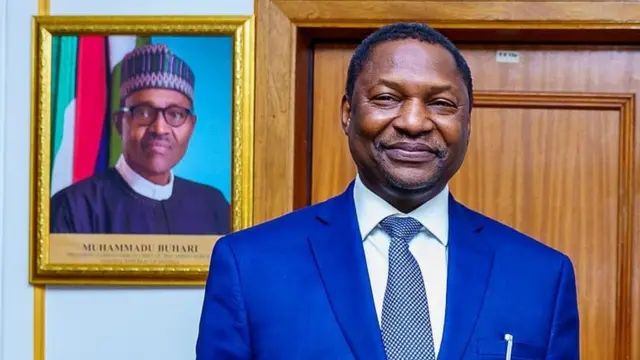
Malami confirmed the invitation through his verified Facebook page on Friday, emphasizing his commitment to transparency and law-abiding conduct.
He did not, however, provide details regarding the reason behind the summons or the specific areas under investigation.
During his eight-year tenure as Nigeria’s Attorney-General and Minister of Justice under former President Muhammadu Buhari, Abubakar Malami exercised supervisory oversight over the EFCC and several other justice-sector agencies.
His tenure was marked by high-profile cases, contentious legal decisions, and reforms aimed at strengthening governance and law enforcement in the country.
The latest development has reignited public interest in his time in office, particularly regarding matters of accountability and oversight.
Now a leading figure in the opposition African Democratic Congress (ADC) and a gubernatorial aspirant in Kebbi State, Abubakar Malami has vowed to honor the EFCC invitation, highlighting his belief in the principles of transparency and accountability.
In his statement, he affirmed, “This is to confirm that I have been invited by the EFCC. As a law-abiding and patriotic citizen, I hereby reaffirm my commitment to honor the invitation.”
Malami’s decision to address the public directly signals a desire to control the narrative and assure citizens that he intends to cooperate fully with the EFCC investigation.
He further pledged to update Nigerians on developments as the process unfolds, reinforcing his commitment to openness in public service.
For many political analysts, this approach underscores a modern approach to accountability, demonstrating that high-profile figures can engage proactively with legal processes while maintaining public confidence.
While the EFCC has not disclosed details regarding the reason for the summons, past practices suggest that former public officeholders may be invited to clarify financial, administrative, or policy-related decisions taken during their tenure.
Given Malami’s role as Attorney-General, the areas under review could involve approvals of government contracts, litigation strategies, asset recovery matters, or oversight of agency operations.
The news has stirred discussions on political, legal, and civic fronts. Advocates of institutional accountability see Malami’s cooperation as a positive step toward strengthening Nigeria’s anti-corruption framework.
Others, however, question whether the timing of the invitation might carry political undertones, considering Malami’s current aspirations in Kebbi State politics.
Nonetheless, Malami has consistently emphasized that his focus remains on lawfulness, public service ethics, and transparent engagement with the EFCC.
Observers note that this is not the first time Malami’s tenure has been scrutinized. During his service from 2015 to 2023, he handled cases with national and international implications, some of which sparked debate over executive influence, legal boundaries, and agency independence.
The current summons, therefore, represents not just a procedural matter but a moment that may shape public perception of his legacy in government.
Despite these debates, Abubakar Malami maintains a firm stance. His repeated emphasis on accountability, transparency, and civic duty demonstrates his intent to comply fully with EFCC requirements.
By pledging to disclose developments publicly, Malami positions himself as a former public official who respects the principles of democratic oversight, even while facing intense public scrutiny.
For the general public, the unfolding situation offers insights into how former officials are held accountable in Nigeria.
Malami’s willingness to submit himself to EFCC questioning can be interpreted as an example of responsible citizenship and adherence to the rule of law.
Civil society groups and legal scholars have noted that such transparency, if maintained throughout the investigation, could serve as a model for future interactions between former public officers and regulatory authorities.
The political dimension remains significant. Malami’s gubernatorial ambitions in Kebbi State make this a high-stakes scenario.
While cooperation with the EFCC could enhance his credibility and demonstrate integrity, any findings or controversies could also influence voter perception.
Analysts argue that the outcome will not only affect his personal and political trajectory but also inform broader discussions on governance, accountability, and public service ethics in Nigeria.
Ireport247news


