

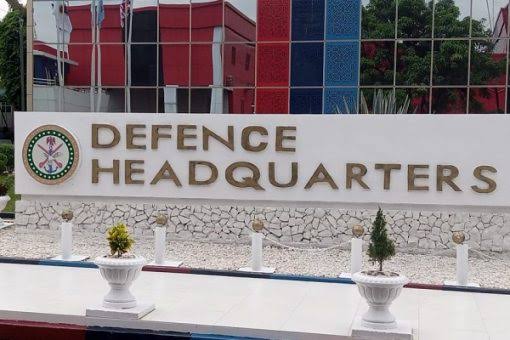
The Defence Headquarters has provided fresh insight into the composition of individuals involved in insurgency, stating that a significant majority—over 60 percent—are not driven by extremist ideology but are instead victims of coercion, abduction, or circumstance.
This assessment has further strengthened the relevance of the national rehabilitation framework known as the Operation Safe Corridor rehabilitation programme.
According to the military authorities, this reality underscores the need to shift emphasis from purely kinetic responses to more structured non-kinetic strategies that focus on healing, reintegration, and long-term stability.
The findings suggest that many individuals engaged in armed groups did not voluntarily choose the path of violence but were drawn into it through force or survival pressure.
The military high command made this known through the National Coordinator of Operation Safe Corridor, Brigadier General Yusuf Ali, during an interaction with journalists in Abuja.
He stressed that national security responses must evolve with emerging realities on the ground, especially in regions affected by insurgency and banditry.
The Operation Safe Corridor rehabilitation programme was introduced in 2016 as a federal government-led initiative designed to encourage surrender, support deradicalisation, and reintegrate low-risk former combatants into civilian life.
It operates as a non-kinetic counter-insurgency strategy and is coordinated by the Defence Headquarters in collaboration with institutions such as the Ministry of Justice, Nigeria and the Nigeria Police Force.
The programme has been particularly associated with the disengagement and reintegration of individuals linked to Boko Haram and related factions.
However, officials say its scope is now expanding beyond former fighters to include victims of violent extremism, reflecting a broader understanding of conflict recovery.
Brigadier General Yusuf Ali explained that the Operation Safe Corridor rehabilitation programme is undergoing structural evolution to become more inclusive and sensitive to the needs of affected communities.
He noted that sustainable peace cannot be achieved if victims of conflict are left without psychological and social support, even as former combatants are rehabilitated.
As part of this shift, the authorities are developing Victims’ Rehabilitation and Reintegration Centres in conflict-affected regions.
These centres are designed to address trauma, displacement, and long-term psychological impacts experienced by communities in areas such as the North-East, North-West, and North-Central geopolitical zones.
Ali revealed that new regional facilities are being established to decentralize rehabilitation efforts.
A Disarmament, Demobilisation and Reintegration (DDR) facility in Tsafe, Zamfara State has already been positioned to address the specific security dynamics of the North-West.
Similarly, another planned centre in Benue State will cater to the North-Central region, with additional centres expected to follow across other zones.
He further emphasized that the Operation Safe Corridor rehabilitation programme is guided by new research findings showing that the majority of foot soldiers in insurgent networks are not ideologically committed.
Instead, they are often victims of coercion, manipulation, or forced recruitment, reinforcing the need for tailored reintegration strategies.
The evolving framework of the programme is now built around three key pillars: stronger vetting and accountability processes, expansion of rehabilitation infrastructure across regions, and a balanced approach that combines disengagement from violence with community healing and restoration.
Officials acknowledge that despite its achievements, the programme continues to face public misconceptions.
Some members of the public mistakenly view it as an amnesty initiative or a loophole for avoiding justice. However, authorities insist this is not the case.
The coordinator clarified that the Operation Safe Corridor rehabilitation programme is not an amnesty scheme, nor is it a mechanism for escaping prosecution.
It also does not serve as a pathway into the armed forces. Instead, it is a structured deradicalisation and reintegration process with strict screening procedures.
To improve transparency and public confidence, the Defence Headquarters and its partners are increasing stakeholder engagement, including collaboration with the Office of the Special Presidential Envoy on Reconstruction and Rehabilitation.
These efforts are aimed at ensuring that citizens better understand the safeguards, objectives, and operational limits of the initiative.
Brigadier General Yusuf Ali, a senior officer of the Yusuf Ali, reiterated that the programme’s evolution reflects a broader national commitment to addressing insecurity through both military action and social rehabilitation.
Ultimately, the Operation Safe Corridor rehabilitation programme is being repositioned as a comprehensive national framework that balances justice, reintegration, and community recovery.
Authorities believe that by addressing both the causes of radicalisation and the consequences of conflict, Nigeria can achieve more sustainable peace and long-term stability across affected regions.I
About The Author
