

Chelsea 3-2 West Ham Premier League comeback delivered one of the season’s most dramatic London derbies as Stamford Bridge witnessed momentum swings, controversy, tactical bravery and late chaos.
West Ham began with intensity and purpose, pressing Chelsea’s midfield aggressively and exploiting space down the flanks during the opening exchanges of the contest.
That early ambition paid dividends as West Ham surged into an unexpected two-goal advantage, capitalising on Chelsea’s sluggish defensive organisation and hesitant recovery runs.

Chelsea struggled to settle after conceding, dominating possession without penetration while West Ham remained compact, disciplined and confident in their defensive positioning.
The early West Ham double lead stunned the home crowd and shifted psychological pressure firmly onto Chelsea, who suddenly faced a rare uphill task.
Chelsea’s build-up play lacked sharpness during the first half, with crosses easily defended and midfield runners failing to attack space between the lines.
West Ham continued to threaten on transitions, using direct balls and quick forward movement to unsettle Chelsea’s high defensive line repeatedly.
As half-time approached, Chelsea grew increasingly frustrated, circulating possession slowly and failing to create clear scoring opportunities against a well-drilled defence.
The interval arrived with Chelsea trailing, leaving Stamford Bridge tense and questioning whether another frustrating league night was unfolding.
The second half marked a turning point as Chelsea emerged with renewed aggression, pressing higher and increasing tempo immediately after the restart.
A clear tactical overhaul was evident, with Chelsea committing more bodies forward and stretching West Ham across the width of the pitch.
Full-backs advanced aggressively, pinning West Ham’s wide players deep and allowing Chelsea sustained territorial dominance inside the opposition half.
Set-pieces and crosses began to pile up as West Ham’s defensive line was forced deeper, absorbing mounting pressure with increasing difficulty.
Chelsea’s persistence was rewarded when a well-worked move resulted in a crucial goal that reignited belief throughout Stamford Bridge.
That breakthrough transformed the atmosphere, lifting Chelsea’s intensity and forcing West Ham into increasingly desperate defensive clearances.
West Ham responded by retreating into a deeper shape, effectively forming a back five in an attempt to protect their narrowing advantage.
Despite the added defensive numbers, Chelsea continued to dominate possession, recycling attacks and probing for weaknesses between defenders.
The equaliser arrived amid sustained chaos inside the penalty area, as Chelsea capitalised on a scramble to restore parity emphatically.
Momentum now belonged entirely to Chelsea, with West Ham visibly struggling to regain composure after surrendering their earlier control.
Substitutions became decisive as fresh attacking legs injected urgency into Chelsea’s forward play, stretching a tiring West Ham defence further.
With belief surging, Chelsea pressed relentlessly for a winner, committing numbers forward while remaining cautious of counterattacking threats.
The decisive moment arrived in stoppage time as Enzo Fernández produced a composed finish to complete an extraordinary turnaround.
Stamford Bridge erupted as the winning goal confirmed a remarkable comeback few would have predicted at half-time.
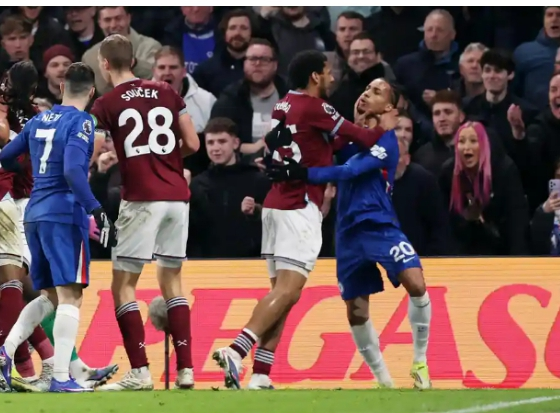
Tempers flared immediately after the goal, with players from both sides involved in heated exchanges across the pitch.
The confrontation escalated into a mass incident that resulted in Jean-Clair Todibo receiving a red card for violent conduct.
The dismissal compounded West Ham’s misery, overshadowing their promising first-half performance and sealing a chaotic conclusion.
Chelsea managed the remaining moments professionally, slowing play and retaining possession to protect their slender advantage.
The final whistle sparked celebrations among home supporters who had witnessed resilience, belief and tactical bravery.
West Ham were left reflecting on a dramatic collapse after executing their game plan effectively for much of the match.
Chelsea’s second-half dominance underlined their ability to adapt, respond under pressure and overwhelm opponents physically and mentally.
The comeback carried historical significance, marking a rare instance of Chelsea overturning a two-goal half-time deficit in league play.
Read also: Didi Hamann: Gerrard could step into Slot’s Liverpool role amid struggles
Tactically, the match highlighted the impact of bold substitutions and structural adjustments made during the interval.
Individually, Enzo Fernández’s influence proved decisive, combining leadership with composure when the stakes were highest.
Marc Cucurella and João Pedro also played key roles, contributing energy, movement and decisive moments in the turnaround.
For West Ham, the result exposed defensive fragility when under sustained pressure and an inability to manage critical moments.
The London derby ultimately encapsulated Premier League unpredictability, emotional extremes and relentless late drama.
Chelsea 3-2 West Ham Premier League comeback will be remembered as a statement victory defined by belief, adjustment and a thrilling finale.
About The Author


