

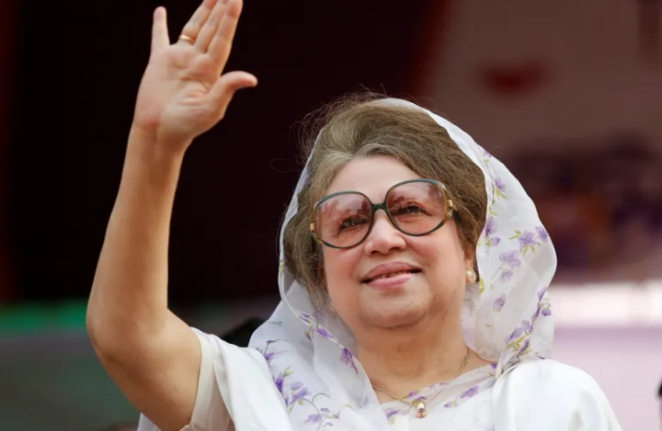
Bangladesh former Prime Minister Khaleda Zia dies following weeks of critical hospitalization, her party confirmed early Tuesday, triggering nationwide mourning and widespread international reactions.
The Bangladesh Nationalist Party announced Khaleda Zia passed away at 6am local time in Dhaka after battling multiple chronic health conditions.
She died at Evercare Hospital, where she had been admitted since late November suffering from severe respiratory complications and other age-related illnesses.
Doctors confirmed Khaleda Zia suffered from advanced liver cirrhosis, diabetes, arthritis, and persistent heart and chest problems that worsened rapidly in recent weeks.
Her death brings to a close more than three decades of political dominance shared with long-time rival Sheikh Hasina, shaping Bangladesh’s modern political identity.
The two leaders, famously dubbed the “battling begums,” alternated power while leading deeply polarized political camps for much of Bangladesh’s post-military era.
Khaleda Zia served as prime minister three times, first assuming office in 1991 following the restoration of parliamentary democracy after years of authoritarian rule.
She was Bangladesh’s first female prime minister, breaking significant political barriers in a predominantly conservative and male-dominated political environment.
Born on August 15, 1946, in Dinajpur, Khaleda Zia grew up during British colonial rule and later witnessed the birth of Pakistan and Bangladesh.
Her early life remained largely private until her marriage to army officer Ziaur Rahman in 1960 changed her personal and political destiny.
Ziaur Rahman emerged as a national figure during Bangladesh’s 1971 war of independence, later becoming president through a military-backed political transition.
Khaleda Zia’s entry into politics followed tragedy, not ambition, after her husband was assassinated during a failed military coup in 1981.
Widowed at 35, she inherited leadership of the Bangladesh Nationalist Party amid national instability and deep uncertainty about civilian governance.
Initially dismissed by critics as inexperienced, Khaleda gradually built political credibility through grassroots mobilization and persistent opposition activism.
She played a key role in mass protests against military ruler Hussain Muhammad Ershad, contributing to his eventual downfall in 1990.
In the landmark 1991 election, Khaleda Zia led the BNP to victory, restoring parliamentary democracy and becoming prime minister for the first time.
Her early reforms included shifting executive power from the presidency to parliament, strengthening civilian control over governance structures.
Khaleda’s government also emphasized economic liberalization, encouraged foreign investment, and expanded access to primary education nationwide.
Despite early successes, her tenure faced accusations of corruption, mismanagement, and growing political polarization within Bangladesh’s fragile democratic framework.
She lost power to Sheikh Hasina in 1996 but returned with a landslide victory in the 2001 general election.
The rivalry between Khaleda Zia and Sheikh Hasina increasingly paralyzed governance, leading to frequent strikes, election boycotts, and street confrontations.
Political tensions peaked in 2007 when Bangladesh entered a military-backed state of emergency amid disputed elections and widespread unrest.
Both Khaleda and Hasina were detained during the emergency period, reflecting the military’s attempt to sideline entrenched political elites.
After elections in 2008, Sheikh Hasina returned to power and dominated Bangladeshi politics for more than fifteen years.
Khaleda Zia gradually found herself marginalized, facing legal battles and restrictions that weakened her political influence.
In 2018, she and her son Tarique Rahman were convicted in a corruption case involving misappropriated foreign donations.
Khaleda consistently denied wrongdoing, describing the charges as politically motivated efforts to eliminate opposition leadership.
She was imprisoned but later transferred to house arrest in 2020 due to deteriorating health conditions.
Her family repeatedly sought permission for overseas medical treatment, requests that were denied by the Hasina-led government.
Following Sheikh Hasina’s violent removal from power in 2024, Khaleda Zia was fully released amid shifting political dynamics.
Earlier this year, Bangladesh’s Supreme Court acquitted Khaleda and her son in the long-running corruption case.
The ruling cleared her name legally but came as her health continued to decline rapidly.
Her death arrives during a pivotal political transition, with her son Tarique Rahman recently returning from exile to lead the BNP.
Rahman is expected to contest the upcoming general election as the BNP’s prime ministerial candidate.
The party announced seven days of national mourning, with funeral arrangements to be communicated later.
Bangladesh’s interim leader Muhammad Yunus described Khaleda Zia as a symbol of democratic resistance and national resilience.
International leaders, including India’s Narendra Modi and Pakistan’s Shehbaz Sharif, expressed condolences and praised her regional contributions.

Supporters remember Khaleda Zia as a steadfast defender of democracy against authoritarianism and political suppression.
Critics, however, argue her confrontational politics deepened divisions and stalled institutional development.
Her legacy remains contested, mirroring the polarized political environment she helped shape.
For many Bangladeshis, her life represents resilience forged through tragedy, struggle, and enduring political rivalry.
Khaleda Zia’s passing closes an era defined by personal sacrifice, fierce competition, and the relentless pursuit of political power.
As Bangladesh moves forward, her influence will continue shaping debates about democracy, governance, and political accountability.
Read also: Italy arrests Hamas fundraising suspects in €7m Gaza aid terror financing investigation
History will judge her not only by controversies but also by her role in restoring civilian rule.
Bangladesh former Prime Minister Khaleda Zia dies leaving behind a nation still grappling with the democratic ideals she championed and contested.
About The Author
