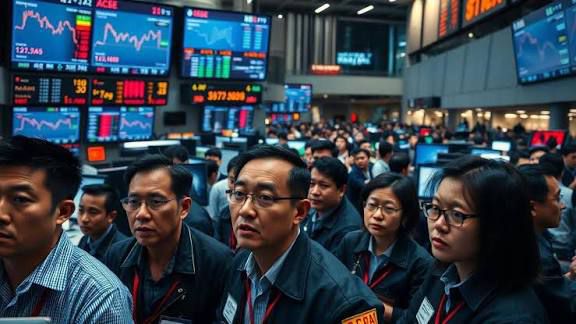
Asian equities ended the week under pressure on Friday as renewed anxiety over ballooning artificial intelligence (AI) investment costs unsettled global markets, reversing earlier optimism around the technology sector and prompting a broader risk-off mood among investors.
The sell-off rippled across regional bourses after sharp losses on Wall Street, where concerns mounted that massive spending on AI infrastructure may take longer than expected to translate into profits.
At the same time, commodity markets cooled, with gold, silver and oil prices retreating amid easing geopolitical tension and profit-taking after recent rallies.
Market sentiment has been fragile throughout the week, shaken by a combination of macroeconomic and political uncertainties, including a weakening US dollar, fresh tariff rhetoric from former US President Donald Trump, warnings directed at Iran, and lingering fears of a potential shutdown of the US government.
Asian stocks slide on AI spending fears and valuation concerns
The immediate trigger for Friday’s downturn was renewed scrutiny of escalating AI-related capital expenditure, particularly after Microsoft disclosed a sharp increase in spending on data centres and AI infrastructure.
While the tech sector had initially been buoyed by strong earnings reports from companies such as Meta, Samsung and SK hynix, investors grew uneasy that the scale of current investments could stretch balance sheets and delay meaningful returns.
Market analysts warned that equity valuations, especially in technology stocks, may have moved into overheated territory following years of AI-driven rallies that pushed major indices to record highs.
According to National Australia Bank strategist Rodrigo Catril, Microsoft’s stock recorded its worst trading session since the COVID-19 market crash, plunging 12 per cent in a single day.
“Microsoft accounted for more than two-thirds of the S&P 500’s decline,” Catril noted, pointing to investor unease over surging AI investment costs, slower-than-expected growth in Azure cloud services, and an extended timeline for monetising AI technologies.
The renewed concerns effectively erased much of the optimism that had built earlier in the week around the profitability of AI-driven expansion.
Wall Street losses spill into Asia
Overnight losses in the US set the tone for Asian trading sessions, with most major indices opening lower and failing to recover as the day progressed.
Wall Street closed mostly in the red, with the Dow Jones Industrial Average managing to eke out modest gains, while the S&P 500 and Nasdaq Composite declined sharply due to heavy selling in technology stocks.
Asian markets mirrored this cautious mood. Investors scaled back exposure to equities perceived as vulnerable to a slowdown in tech earnings growth, particularly those tied to semiconductors, cloud computing and AI hardware.
Market participants said the retreat reflected a growing reassessment of risk, as traders weighed the long-term promise of AI against the near-term financial strain of unprecedented capital outlays.
Commodities retreat as safe-haven demand eases
Beyond equities, commodity markets also saw a pullback on Friday.
Gold and silver prices slipped sharply after hitting multiple record highs earlier in the week, as traders locked in profits and reduced safe-haven positions.
Analysts said the retreat in precious metals was partly driven by signs of easing geopolitical tension, particularly speculation around a potential de-escalation in US-Iran relations.
Oil prices also edged lower, reflecting similar hopes that diplomatic channels could reduce the risk of supply disruptions.
The pullback marked a pause in a strong rally that had been fuelled by geopolitical anxiety, inflation concerns and expectations of looser global monetary conditions.
Political uncertainty adds to market volatility
Political developments in the United States further compounded market unease.
Asian investors remained cautious amid speculation that Donald Trump could nominate Kevin Warsh, a former Federal Reserve governor widely regarded as hawkish on interest rates, as the next chair of the US central bank.
Trump is expected to announce his preferred successor to Jerome Powell on Friday morning US time, a decision that could have far-reaching implications for global monetary policy and financial markets.
A potential shift toward a more aggressive stance on interest rates could strengthen the US dollar and tighten global financial conditions, adding pressure to emerging and frontier markets across Asia.
At the same time, renewed tariff threats and trade rhetoric have revived fears of protectionist policies that could disrupt supply chains and dampen global growth.
Are markets in bubble territory?
The sharp reaction to Microsoft’s spending plans has reignited debate over whether parts of the global equity market are approaching bubble territory, particularly within the technology sector.
After years of strong gains driven by digitalisation, cloud computing and now AI, investors are increasingly questioning whether earnings growth can keep pace with lofty valuations.
Some analysts argue that while AI remains a transformative force with long-term potential, markets may have priced in too much optimism too quickly, leaving stocks vulnerable to sharp corrections whenever expectations are challenged.
“The issue is not whether AI will deliver value,” said one Asia-based fund manager. “It’s about timing. Markets are struggling with the gap between today’s investment costs and tomorrow’s potential returns.”
What lies ahead for Asian markets?
Looking ahead, analysts expect Asian markets to remain volatile in the near term, with sentiment likely to hinge on upcoming economic data, central bank signals and further guidance from major technology firms on capital spending and profitability.
Investors will also be watching developments in Washington closely, including decisions on fiscal policy, trade and monetary leadership, all of which could reshape global risk appetite.
For now, the sharp sell-off serves as a reminder that while AI continues to captivate investors, the path to sustainable returns may be longer and more complex than recent market rallies have suggested.
As Asian stocks slide amid rising AI spending fears, market participants are increasingly adopting a more cautious stance—balancing enthusiasm for innovation with growing concern over valuation, policy uncertainty and the true cost of the next technological revolution.
About The Author