Asian Markets Climb Ahead of Critical US Economic Indicators
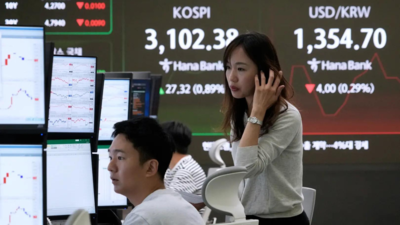
Asian markets mostly rose on Wednesday, December 3, 2025, following a resumption of Wall Street’s rally. Gains were modest, however, as investors awaited the final tranche of US economic data before next week’s Federal Reserve meeting.
With expectations already pricing in a third consecutive interest rate cut, traders remain cautious, anticipating new signals from the upcoming private jobs report and the personal consumption expenditure (PCE) index.
The PCE, the Federal Reserve’s preferred measure of inflation, will be closely watched to determine whether further policy easing is warranted.
Analysts note that even small deviations in the index could alter market expectations, potentially impacting trading sentiment in Asia.
Money markets currently indicate a roughly 90 percent probability of a December 10 rate cut, with forecasts suggesting three additional reductions may follow in 2026.
Asian markets have drawn optimism from reports that President Donald Trump’s top economic adviser, Kevin Hassett, is the frontrunner to lead the Fed once Jerome Powell’s tenure ends in May.
Hassett’s pro-cut stance has boosted hopes of accommodative monetary policy, though debate persists on whether the Fed should prioritize the soft labor market or contain persistent inflation.
Fabien Yip, market analyst at IG, explained:
“Friday’s core PCE index represents the final major inflation gauge before the Fed’s December policy meeting.
Any deviation could alter expectations regarding the Fed’s policy stance, particularly as the central bank weighs inflation persistence against a softening labor market.”
Asian Markets Respond to US Jobs and Spending Data
The private payroll report from ADP, due later in the week, will also influence Asian markets, providing early insights into US employment trends.
Meanwhile, the National Retail Federation reported robust domestic consumer activity during the Black Friday holiday weekend, with 202.9 million shoppers recorded over five days—topping expectations.
Analysts see this as evidence of a resilient consumer base, potentially supporting global growth projections.
On Wall Street, all three major indexes closed in positive territory, creating a lift for Asian markets.
Tokyo’s Nikkei 225 gained more than one percent, with Seoul, Sydney, Singapore, Wellington, Taipei, and Jakarta also recording gains.
Meanwhile, Hong Kong, Shanghai, Mumbai, Bangkok, and Manila experienced declines amid regional variations in investor sentiment.
Currency markets were equally sensitive to US developments.
The Indian rupee weakened past 90 per dollar, extending losses throughout the year.
Analysts attribute the fall primarily to foreign fund outflows and the uncertainty surrounding India-US trade negotiations.
Dilip Parmar, an HDFC Securities analyst, noted that the rupee’s depreciation reflects a classic imbalance between demand and supply, compounded by insufficient central bank intervention.
Asian Markets Show Mixed Performance Amid Global Volatility
Despite broad gains, some Asian markets faced downward pressure due to local factors.
Shanghai and Hong Kong’s main indexes fell by 0.5 percent and 1.3 percent, respectively, as investors digested weaker corporate earnings and regional economic signals.
Meanwhile, European markets opened mixed, with London’s FTSE 100 slightly down while Paris and Frankfurt edged higher.
Commodity prices offered additional support to Asian markets.
West Texas Intermediate crude increased by 0.5 percent to $58.95 per barrel, and Brent North Sea crude rose similarly to $62.74 per barrel.
The modest uptick in oil prices provided relief for energy-dependent economies in the region, sustaining broader investor optimism.
Bitcoin also saw a rebound, climbing above $90,000 after a recent slump below $81,000.
While digital assets remain volatile, their performance has a growing impact on Asian markets, particularly in regions with high cryptocurrency adoption.
Analyst Perspectives on Asian Markets and Fed Policy
Market analysts argue that Asian markets are highly sensitive to US monetary policy developments, which influence capital flows, trade projections, and investor sentiment.
Raj Gaikar, research analyst at SAMCO Securities, highlighted that the Reserve Bank of India’s recent policy decisions, including selective interventions to defend the rupee, aim to balance growth and currency stability.
Such measures, he noted, reduce the need for aggressive central bank action, allowing markets to adjust naturally.
Andrew Brenner of NatAlliance Securities suggested that the Fed’s policy could result in a “hawkish cut,” reflecting the delicate balance between supporting a soft labor market and controlling inflation.
This nuanced approach underscores why Asian markets remain on alert as US data releases approach.
Asian Markets Navigate Global Risks and Investment Opportunities
Investors in Asia are also considering broader macroeconomic factors, including trade negotiations, geopolitical tensions, and domestic fiscal policies.
For instance, India’s challenge in striking a trade deal with the US continues to influence investor confidence, affecting currency and equity markets alike.
Similarly, regional growth disparities and energy price volatility create uneven performance across Asian markets.
Despite these challenges, opportunities remain. Consumer demand in the US, combined with accommodative Fed policy, can stimulate exports from Asia, supporting corporate earnings and regional equity performance.
Market watchers emphasize that disciplined risk management and strategic positioning will be key for investors navigating these conditions.
Asian Markets at a Crossroads
As major US economic data points loom, Asian markets are poised at a critical juncture.
Investors must balance optimism from Wall Street’s rally and resilient consumer spending with caution surrounding Fed policy decisions and global uncertainties.
While gains are encouraging, volatility persists, reminding traders and policymakers alike that Asian markets remain tightly linked to international economic signals.
The performance of Asian markets this week underscores the interconnected nature of the global economy and the ongoing influence of US monetary policy.
With investors closely watching jobs, inflation, and spending data, regional markets face both risks and opportunities in equal measure, shaping the trajectory for the remainder of 2025 and beyond.