A fierce Alaba Market Fire in Lagos razed several shops, leaving traders devastated and goods worth millions destroyed despite firefighters’ desperate rescue efforts.
A fierce Alaba Market Fire on Tuesday evening tore through parts of the famous Alaba International Market in Lagos, leaving behind a trail of destruction, despair, and financial ruin.
The inferno consumed numerous shops and warehouses, forcing traders to watch helplessly as their goods worth millions of naira went up in flames.
The Alaba Market Fire began around dusk and spread rapidly across several sections of the sprawling electronics and building materials hub located along the Lagos–Badagry Expressway.
Witnesses described chaotic scenes as thick black smoke filled the air and desperate traders screamed for help.
Social media was flooded with live footage of the incident, including a TikTok broadcast by a user identified as KB Clothings, which captured moments of panic and devastation.
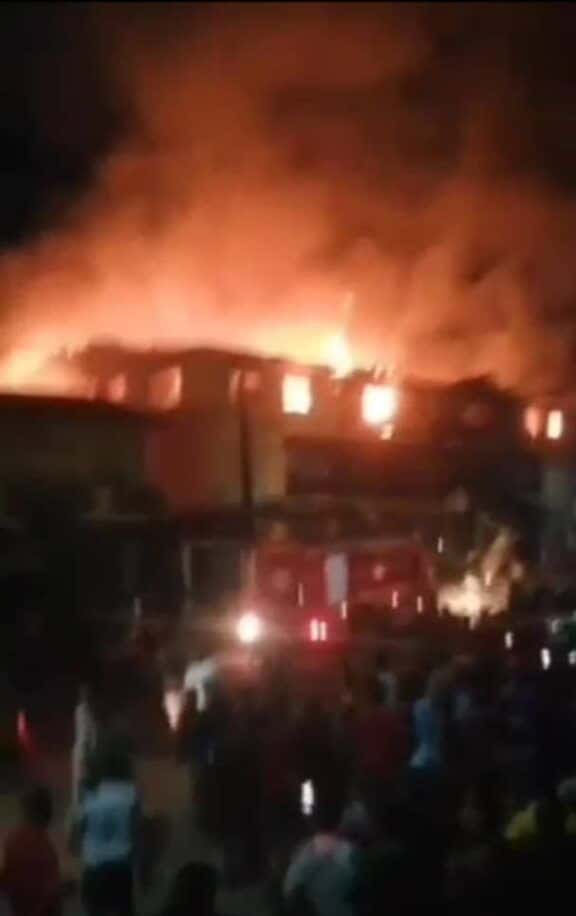
In the video, terrified traders tried to salvage their goods, while others were reduced to tears as the fire devoured their life’s investments.
Operatives of the Lagos State Fire and Rescue Service raced to the scene shortly after receiving distress calls.
Firefighters battled the flames for several hours, trying to prevent the blaze from spreading to nearby stalls. However, despite their best efforts, the Alaba Market Fire continued to rage well into the night, fueled by flammable materials such as plastics, electrical appliances, and wooden furniture.
Eyewitnesses said the fire started in one section of the electronics wing and quickly escalated due to poor fire response and limited access routes.
“It started small, but before anyone could react, it had covered the whole row,” a distraught trader recounted. Another added that the market’s internal security reacted too slowly, allowing the flames to spread unchecked.
Traders broke down in tears as they watched their goods burn. Some risked entering the burning structures to rescue cash, documents, and inventory.
Others stood helplessly, calling on the government to intervene and help rebuild what was lost.
“We have lost everything,” one trader cried. “This is all we have to feed our families. We need urgent help.”
Officials from the Lagos State Emergency Management Agency (LASEMA) later joined the firefighting effort, helping to cordon off the affected area and prevent further destruction.
However, rescue workers faced major challenges, including inadequate access to water and narrow pathways that hindered movement of fire trucks.
Preliminary reports suggested that the Alaba Market Fire might have been triggered by an electrical fault or generator explosion, though authorities have yet to confirm the exact cause.
A full investigation has been ordered by the Lagos State Government to determine the origin of the fire and the total value of goods lost.
The Alaba International Market is one of West Africa’s largest trade centers, known for its booming sales of electronics, appliances, and construction materials.
Thousands of traders and customers from across Nigeria and neighboring countries such as Ghana, Togo, and Benin Republic rely on the market daily for business transactions.
Unfortunately, market fires are becoming alarmingly frequent in Lagos and other parts of Nigeria. In the past few years, several major markets—including Balogun, Oyingbo, and Ladipo—have been gutted by similar infernos, resulting in massive economic losses and job cuts.
Experts warn that without better safety measures, these recurring tragedies will continue to cripple the informal economy.
Economists and business leaders have emphasized that incidents like the Alaba Market Fire deepen poverty and disrupt regional supply chains.
They urge the government to prioritize preventive infrastructure such as fire hydrants, smoke detectors, and accessible emergency exits in major markets.
Margaret Adeseye, spokesperson for the Lagos State Fire and Rescue Service, confirmed that firefighters worked tirelessly throughout the night to bring the fire under control.
She urged traders to remain calm and cooperate with officials during damage assessment. “We understand the pain of our traders, but safety must come first,” she stated.
Market associations have begun compiling lists of affected traders and estimating financial losses. Early reports suggest that goods worth several billions of naira may have been destroyed, although official figures are still being verified.
Meanwhile, appeals have gone out to both the Lagos State and Federal Governments to provide urgent support to affected victims. Many traders, who operate on loans, fear they will be unable to recover without financial assistance.
“This market supports thousands of families. Without immediate relief, many people will be thrown into poverty,” lamented a market leader, Mr. Johnson Eze. He called for interest-free loans and grants to help traders rebuild their businesses.
Humanitarian organizations and civil society groups have also expressed concern, calling for stronger enforcement of fire safety regulations and public education campaigns on emergency preparedness.
“We must move from reaction to prevention,” said Mrs. Omotola Adebayo, a disaster risk management advocate.
“It’s time to modernize our markets and protect lives and livelihoods.”
As dawn broke on Wednesday, the full scale of destruction at Alaba International Market became clear.
Rows of burnt shops stood as blackened shells, and the air reeked of smoke and melted plastic. Traders moved silently among the ruins, searching for anything they could salvage.
For many, the tragedy was not just about property loss but a blow to years of hard work and survival.
“Everything I worked for is gone,” said a trader in tears. “I don’t know where to start again.”
The Alaba Market Fire once again underscores the urgent need for Nigeria to strengthen urban fire management systems, implement routine safety audits in public markets, and ensure compliance with building regulations.
Until proactive measures replace reactionary responses, the cycle of loss and despair is bound to continue.
More news at ireport247news
About The Author