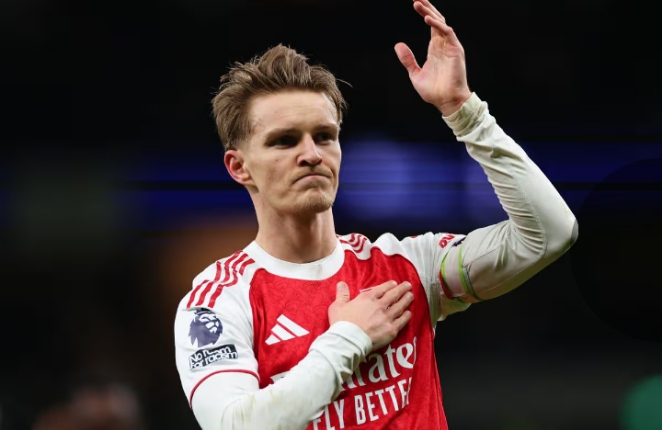
Martin Odegaard absent for Arsenal vs Chelsea has emerged as the major talking point ahead of the Premier League clash at the Emirates Stadium, dealing Mikel Arteta a frustrating late setback.
The Arsenal captain was left out of the matchday squad despite recently returning from injury, raising renewed concerns over his fitness at a decisive stage of the season.
Arsenal entered the contest sitting top of the Premier League table, with momentum firmly behind them following recent domestic and European performances under Arteta’s guidance.
Odegaard’s absence represents a significant loss of leadership and creativity, particularly in a high-intensity fixture against traditional rivals Chelsea in front of a packed Emirates crowd.
The Norwegian midfielder had only just resumed involvement after recovering from a knee problem, making his omission all the more concerning for Arsenal’s coaching staff.
Arteta confirmed before kick-off that the decision was taken as a precaution, insisting the club were unwilling to take unnecessary risks with Odegaard’s long-term fitness.
The Arsenal manager stressed that the midfielder was still experiencing discomfort, prompting medical staff to advise rest rather than potential aggravation of the issue.
Despite Odegaard’s absence, Arteta opted to name an unchanged starting XI, reflecting confidence in the side that recently delivered an impressive derby victory.
Arsenal’s attacking structure once again featured Eberechi Eze and Viktor Gyökeres, both rewarded after scoring braces in the previous league outing.
Their inclusion signalled Arteta’s intent to maintain continuity, relying on form players to compensate for the absence of their influential captain.
Leandro Trossard retained his role on the left flank, while Piero Hincapié provided balance and defensive solidity in a slightly adjusted tactical setup.
The midfield dynamic inevitably shifted without Odegaard, with Arsenal prioritising intensity, pressing and direct progression rather than intricate central combinations.
Arteta explained that adaptability has been a cornerstone of Arsenal’s title push, particularly when managing injuries to key personnel across multiple competitions.
Chelsea arrived in north London seeking consistency after an uneven campaign, but aware of the opportunity presented by Arsenal missing their primary creative force.
Chelsea head coach Liam Rosenior made several notable selections, aiming to exploit spaces in Arsenal’s midfield structure.
Mamadou Sarr was deployed at centre-back, while Cole Palmer operated from the right, adding pace and unpredictability to Chelsea’s attacking transitions.
Enzo Fernández was tasked with a more advanced central role, linking midfield and attack in an attempt to disrupt Arsenal’s defensive organisation.
From Arsenal’s perspective, the bench did provide a significant boost, with Kai Havertz returning after a spell sidelined by a muscular issue.
Havertz’s availability offered Arteta a valuable tactical option, particularly against his former club, where his experience could prove decisive late in the match.
The Germany international has previously delivered in big moments, including scoring during Arsenal’s Carabao Cup semi-final success earlier in the campaign.
Arteta confirmed Havertz had trained well in the lead-up to the fixture, expressing confidence in his readiness to contribute despite limited recent minutes.
While Havertz’s return softened the blow, the absence of Odegaard remained the dominant narrative, given his central role in Arsenal’s attacking identity.
Odegaard has been instrumental throughout the season, dictating tempo, pressing aggressively, and providing consistent goal contributions from midfield.
His leadership on and off the pitch has also been a defining feature of Arsenal’s resurgence as genuine title contenders under Arteta.
Without him, responsibility for creativity fell more heavily on wide players and advanced midfield runners breaking beyond the defensive line.
Arteta has repeatedly emphasised squad depth as essential during the title run-in, particularly with fixture congestion and physical demands increasing.
Arsenal’s medical staff are understood to be cautious, prioritising Odegaard’s availability for the decisive final stretch rather than risking a longer absence.
The club remains optimistic that the issue is minor, though no definitive timeline has been provided for the midfielder’s return to match action.
Chelsea, meanwhile, viewed Odegaard’s absence as a potential opening, though aware Arsenal have repeatedly shown resilience when missing key figures.
The fixture carried significant implications at both ends of the table, with Arsenal targeting maximum points and Chelsea aiming to reassert momentum.
Arteta’s calm pre-match messaging reflected confidence in his squad’s mentality, highlighting collective responsibility rather than individual dependency.
Arsenal supporters, while disappointed to see their captain sidelined, have grown accustomed to Arteta rotating effectively during challenging periods.
Read also: Arteta calms Arsenal injury concerns after crucial Chelsea victory
The Emirates atmosphere remained expectant, buoyed by Arsenal’s recent form and belief that the team can overcome adversity.
As the season enters its defining phase, managing player fitness will be crucial, particularly for leaders like Odegaard whose influence extends beyond statistics.
For now, Martin Odegaard absent for Arsenal vs Chelsea stands as a reminder of the fine margins shaping the Premier League title race.
Whether precaution proves wise will become clearer in the coming weeks, as Arsenal balance ambition with the long-term health of their captain.
About The Author